ERP buying has changed. Many vendors now encourage businesses to start small, go live quickly, and expand later. On the surface, this feels practical and cost-friendly. But for many organisations, this approach creates hidden risks that surface months or years later.
This is why decision-makers ask what is land and expand strategy in ERP and whether it is actually safe. In this blog, you will learn what land and expand means in ERP, how it works in real projects, and why it is increasingly seen as a threat to ERP success. We will also explain how this model affects large platforms like oracle ERP cloud solutions, and what businesses should consider before agreeing to this approach during an oracle ERP implementation or any ERP rollout.
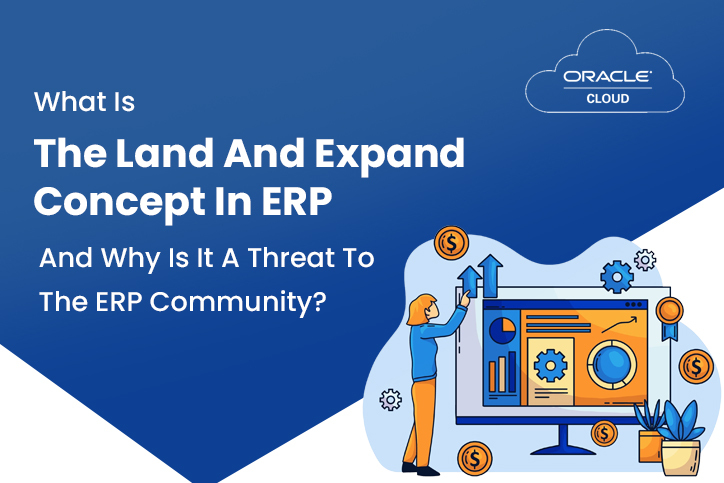
What Is The Land And Expand Strategy In ERP?
The land and expand strategy in ERP means implementing a limited version of the system first, then gradually adding modules, users, and functionality over time.
In practice, vendors or partners “land” the ERP by deploying core finance or a single module. Once the system is live and embedded, they “expand” by upselling additional features, integrations, and users. This model is often positioned as faster, cheaper, and less risky at the start.
Why Did The Land And Expand Strategy Become Popular In ERP Projects?
Land and expand became popular because businesses wanted faster go-live timelines and lower upfront costs.
Cloud ERP platforms made it technically easier to start small. Sales teams also adopted this approach to reduce buying friction. For ERP vendors, this model increases long-term revenue by locking customers into the platform early.
Why Is Land And Expand Risky For ERP Projects?
Yes, is land and expand risky for ERP projects is a valid concern, because the risk is shifted from the start of the project to later phases.
The biggest issue is that early design decisions are made without a full view of future requirements. What looks simple during phase one often becomes expensive and complex during expansion. Data models, workflows, and integrations may not scale cleanly.
How Does Land And Expand Create Long-Term ERP Problems?
Land and expand often leads to fragmented system design.
Common problems include duplicated data, inconsistent processes across departments, and heavy customisation to patch early gaps. Each expansion phase adds cost, testing effort, and downtime. Over time, the ERP becomes harder to upgrade and support.
Why Does Land And Expand Affect ERP Governance And Planning?
ERP governance depends on clear scope, ownership, and architecture decisions.
With land and expand, governance is often postponed. Decisions are made reactively instead of strategically. This weakens control over integrations, security, and reporting standards, especially in multi-entity or regulated environments.
How Does Land And Expand Impact ERP Solutions?
Land and expand is frequently used in ERP projects, especially for finance-first implementations.
While most ERPs are robust, starting with a narrow scope can limit how well modules like supply chain, projects, or procurement integrate later. Poor initial design can force rework during expansion, increasing implementation cost and timeline.
What Risks Does Land And Expand Introduce During ERP Implementation?
During an ERP implementation, land and expand can understate true project effort.
Phase one budgets often exclude future integration, reporting, and change management costs. When expansion begins, stakeholders face unexpected spend, user resistance, and extended stabilisation periods.
Why Is Land And Expand Considered A Threat To The ERP Community?
Land and expand is seen as a threat because it prioritises short-term sales success over long-term system health.
It damages trust in ERP projects when promised simplicity turns into continuous cost. It also shifts responsibility away from upfront solution design, which is critical for ERP success. Over time, this hurts both customers and implementation partners.
When Can Land And Expand Work Safely In ERP Projects?
Land and expand can work if it is planned deliberately.
It is safer when future phases are clearly defined, data models are designed for scale, and governance is established from day one. Without this discipline, the approach becomes reactive and costly.
What Is A Better Alternative To Land And Expand In ERP?
A phased implementation with full-scope design is a stronger alternative.
This means designing the complete ERP architecture upfront, even if rollout happens in stages. It reduces rework, controls cost, and keeps reporting and integrations consistent.
Planning An ERP Implementation Or Expansion?
Understanding what is land and expand strategy in ERP helps businesses avoid long-term surprises. While it promises speed and flexibility, is land and expand risky for ERP projects depends on how well future needs are planned from the start. For platforms like oracle, Microsoft ERP cloud solutions, success depends on strong upfront design, governance, and realistic scoping. ERP works best when expansion is intentional, not accidental.
If you are evaluating ERP options or planning an ERP implementation, SoftArt can help you design a scalable roadmap that avoids hidden expansion risks. We focus on upfront clarity, clean architecture, and long-term system stability.
Contact SoftArt: +971 521490790
Email: connect@softart.co
FAQs
Q. What Is Land And Expand Strategy In ERP In Simple Terms?
It means starting with a small ERP setup and adding features later instead of implementing everything at once.
Q. Is Land And Expand Risky For ERP Projects?
It can be risky if future needs are not planned upfront, leading to rework, higher costs, and system complexity.
Q. Is Land And Expand Common In Oracle ERP Cloud Solutions?
Yes. Many Oracle ERP Cloud projects start with finance modules and expand later, which requires careful planning.
Q. Should I Avoid Land And Expand During Oracle ERP Implementation?
Not always. It should only be used when future phases are clearly designed and governed from the start.
Q. What Is The Biggest Mistake With Land And Expand ERP Projects?
The biggest mistake is treating expansion as an afterthought instead of designing for scale from day one.