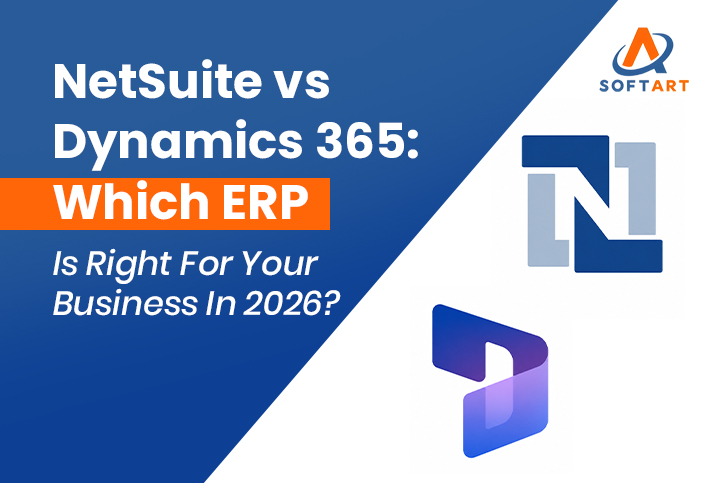
ERP selection in 2026 is no longer only about finance or inventory management. Businesses now evaluate scalability, AI readiness, integrations, reporting visibility, automation, operational flexibility, and long-term support before selecting a platform. This is why many growing companies actively compare NetSuite vs Dynamics 365 before making a final ERP decision.
Here is the direct answer. NetSuite is often preferred by businesses looking for a unified cloud ERP with strong multi-entity management, centralized reporting, and global scalability. Dynamics 365 is commonly chosen by organizations already invested in the Microsoft ecosystem and looking for deeper integration with Microsoft tools, Power BI, Teams, Outlook, and Azure services.
At SoftArt, we help businesses evaluate ERP platforms based on operational complexity, reporting structure, growth plans, integration requirements, and long-term usability. Whether companies need structured dynamics 365 business central consulting services USA, scalable NetSuite integration services, or guidance from experienced netsuite partners USA, the focus should always remain on operational fit and long-term business value.
Read on to understand the real differences between NetSuite and Dynamics 365 in 2026.
What Is The Main Difference Between NetSuite And Dynamics 365?
The biggest difference between NetSuite vs Dynamics 365 UAE is the way the platforms are designed and deployed.
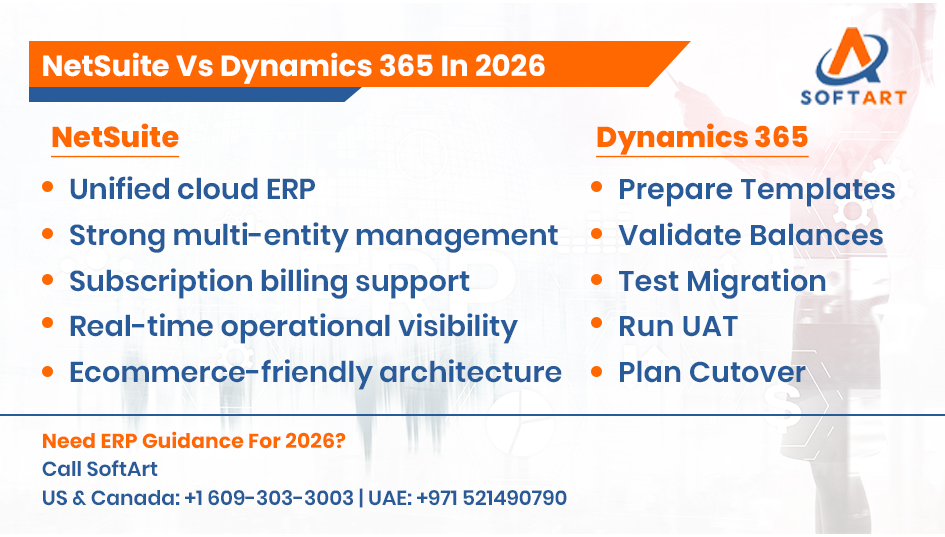
NetSuite operates as a unified cloud ERP platform where finance, CRM, inventory, procurement, ecommerce, and reporting work inside one connected ecosystem.
Dynamics 365 follows a modular Microsoft approach. Businesses can combine applications such as:
- Business Central
- Finance & Operations
- Sales
- Customer Service
- Power Platform
- Power BI
This creates flexibility but may also increase dependency on the broader Microsoft environment.
| Area | NetSuite | Dynamics 365 |
|---|---|---|
| Platform Structure | Unified ERP suite | Modular Microsoft ecosystem |
| Deployment Model | Cloud-native ERP | Cloud ERP with Microsoft ecosystem integration |
| Core Strength | Multi-entity visibility and scalability | Productivity and Microsoft integration |
| Typical Buyer | Growth-focused businesses | Microsoft-centric organizations |
| Ecosystem Dependency | Lower | Higher |
Which Businesses Usually Choose NetSuite In 2026?
NetSuite is commonly selected by businesses that need centralized operations across multiple departments, entities, or regions.
Industries where NetSuite performs strongly include:
- SaaS and subscription businesses
- Ecommerce and retail
- Wholesale distribution
- Professional services
- Manufacturing and inventory-heavy businesses
- High-growth startups
Businesses often choose NetSuite because it supports:
- Multi-subsidiary consolidation
- Global financial reporting
- Real-time dashboards
- Subscription billing
- Unified operational visibility
- Scalable cloud infrastructure
Many companies also rely on specialized NetSuite implementation services to connect NetSuite with ecommerce platforms, CRM systems, warehouse applications, payroll tools, and BI platforms.
Which Businesses Usually Choose Dynamics 365 in 2026?
Dynamics 365 is commonly preferred by businesses already using Microsoft technologies extensively.
This includes organizations that work heavily with:
- Microsoft 365
- Teams
- Outlook
- Excel
- Azure
- Power BI
- Power Platform
Dynamics 365 is often selected when businesses want:
- Familiar Microsoft-based workflows
- Flexible modular deployment
- Deep productivity integration
- Strong reporting through Power BI
- Simplified collaboration across Microsoft tools
Companies also engage dynamics 365 business central consulting services USA to structure workflows, reporting, migrations, and integrations correctly during implementation.
How Do NetSuite And Dynamics 365 Compare For Financial Management?
Both ERP systems provide strong financial management capabilities, but the strengths differ slightly depending on business structure and reporting needs.
NetSuite Financial Strengths
NetSuite is particularly strong in:
- Multi-entity consolidation
- Intercompany accounting
- Revenue recognition
- Global financial reporting
- Real-time financial dashboards
- Automated billing workflows
This makes NetSuite attractive for businesses managing subsidiaries, international operations, or rapid expansion.
Dynamics 365 Financial Strengths
Dynamics 365 performs strongly in:
- Budget planning
- Microsoft Excel integration
- Power BI financial analytics
- Workflow customization
- Operational reporting
- Productivity-driven finance processes
Businesses already operating inside Microsoft environments often adapt quickly to Dynamics 365 workflows.
Which ERP Is Better For Scalability In 2026?
Scalability depends on operational complexity, geographic growth, integrations, and reporting requirements.
NetSuite is often considered easier for centralized global scaling because of its unified architecture. Businesses benefit from:
- Shared master data
- Centralized reporting
- Built-in multi-subsidiary support
- Native multi-currency management
- Cloud-first scalability
Dynamics 365 scalability is also strong, but it often depends more heavily on:
- module architecture
- Microsoft environment maturity
- integration planning
- deployment structure
This is why businesses frequently involve dynamics 365 business central consulting services USA during growth-stage ERP planning.
How Do AI & Automation Compare In 2026?
AI capabilities now play a major role in ERP evaluation.
NetSuite AI Direction
Oracle continues investing heavily in AI-driven ERP functionality through:
- NetSuite Next capabilities
- AI-assisted workflows
- Predictive analytics
- Natural language interaction
- Intelligent operational automation
Oracle positions AI as part of daily ERP interaction rather than a separate tool layer.
Dynamics 365 AI Direction
Dynamics 365 focuses strongly on:
- Microsoft Copilot
- AI-assisted productivity
- Business Central Copilot
- Power Platform automation
- AI-driven reporting and analysis
Microsoft’s strength is particularly visible in productivity assistance and workflow automation across applications.
Which ERP Has Better Integration Flexibility?
Integration flexibility depends on the business environment and operational ecosystem.
NetSuite Integration Strengths
Businesses using ecommerce, CRM, payroll, logistics, or external reporting systems often require structured NetSuite integration services.
Common NetSuite integrations include:
- Shopify
- Salesforce
- Amazon
- HubSpot
- Payroll platforms
- Warehouse management systems
- Business intelligence tools
Strong integration planning is important because poor integration structure can damage reporting accuracy and operational visibility.
Many businesses work with experienced NetSuite partners USA to design scalable integrations and avoid future workflow issues.
Dynamics 365 Integration Strengths
Dynamics 365 integrates naturally with:
- Microsoft 365
- Teams
- Outlook
- Power Apps
- Power Automate
- Azure services
- Power BI
This creates a strong advantage for organizations already operating inside Microsoft ecosystems.
Which ERP Is Easier For Users To Adopt?
User adoption depends on training quality, implementation structure, and employee familiarity with the ecosystem.
NetSuite User Experience
NetSuite provides:
- Centralized dashboards
- Unified workflows
- Cross-functional visibility
- Role-based permissions
- Real-time operational reporting
However, adoption still depends heavily on implementation quality and training.
Dynamics 365 User Experience
Dynamics users often adapt faster when teams already work inside:
- Excel
- Outlook
- Teams
- Microsoft 365
The familiar interface reduces learning friction for many users.
How Do Costs Compare Between NetSuite And Dynamics 365?
ERP cost depends on:
- number of users
- modules selected
- integrations required
- implementation complexity
- support structure
- customization requirements
NetSuite Cost Structure
NetSuite generally includes:
- subscription licensing
- module-based pricing
- user licensing
- implementation costs
- integration costs
Businesses often work with netsuite partners USA to estimate long-term ownership cost more accurately.
Dynamics 365 Cost Structure
Dynamics pricing depends on:
- selected modules
- Business Central vs Finance & Operations
- Microsoft licensing environment
- Power Platform usage
- deployment structure
Both ERP platforms require careful total cost evaluation beyond software subscription alone.
When Do Dynamics 365 Business Central Consulting Services USA Become Important?
Businesses often require dynamics 365 business central consulting services USA when they have:
- complex workflows
- multi-entity operations
- advanced reporting needs
- migration challenges
- integration-heavy environments
Consulting becomes important for:
- ERP architecture planning
- workflow governance
- reporting design
- user adoption
- implementation stability
Without structured consulting, businesses may face reporting inconsistencies and operational inefficiencies later.
Why Do Businesses Work With NetSuite Partners USA?
Experienced netsuite partners USA help businesses implement ERP more effectively while reducing operational risk.
Implementation partners commonly support:
- ERP planning
- process mapping
- integration architecture
- reporting setup
- workflow optimization
- post-go-live support
Businesses also depend on netsuite integration services to maintain clean operational visibility across departments and systems.
Which ERP Is Better For Small Businesses?
For smaller businesses:
- Dynamics Business Central may feel simpler for Microsoft-focused teams
- NetSuite may provide stronger long-term scalability for rapidly growing companies
The better ERP depends on:
- growth plans
- reporting complexity
- operational structure
- integration requirements
- international expansion goals
There is no universal winner.
Which ERP Is Better For Multi-Entity Businesses?
NetSuite is often considered particularly strong for:
- multi-subsidiary operations
- global financial consolidation
- intercompany accounting
- multi-currency reporting
- centralized operational visibility
Dynamics 365 can also support these environments, but implementation complexity may vary depending on architecture and deployment structure.
What Should Businesses Evaluate Before Choosing ERP In 2026?
Before selecting ERP, businesses should evaluate:
- operational complexity
- reporting requirements
- integration dependencies
- AI roadmap
- scalability goals
- user adoption readiness
- compliance requirements
- internal technical maturity
ERP selection should support long-term operational strategy, not only immediate requirements.
Get Expert ERP Guidance From SoftArt
The decision between NetSuite vs Dynamics 365 should be based on operational fit, reporting structure, scalability requirements, integrations, and long-term usability. Both ERP platforms are powerful, but the right ERP depends on how your business plans to grow and operate over time.
At SoftArt, we help businesses evaluate ERP platforms, structure implementations, optimize workflows, and plan integrations for long-term stability. Whether companies need dynamics 365 business central consulting services USA, scalable netsuite integration services, or guidance from experienced netsuite partners USA, our focus remains practical ERP success, reporting clarity, and operational scalability.
SoftArt supports businesses with:
- ERP consulting and planning
- Implementation governance
- Workflow optimization
- Integration architecture
- Reporting setup
- Post-go-live support
Contact SoftArt
- Email: info@softart.co
- US & Canada: +1 609-303-3003 | UAE: +971 521490790
Frequently Asked Questions
What Is The Main Difference Between NetSuite Vs Dynamics 365?
The main difference between NetSuite vs Dynamics 365 is platform structure. NetSuite is a unified cloud ERP platform, while Dynamics 365 uses a modular Microsoft ecosystem approach connected with Microsoft productivity tools and applications.
Which ERP Is Better For Growing Businesses In 2026?
Both ERP systems support growth, but NetSuite is often preferred for centralized multi-entity scalability, while Dynamics 365 is commonly chosen by Microsoft-focused organizations requiring ecosystem flexibility.
Why Are Netsuite Integration Services Important?
netsuite integration services help businesses connect ERP with ecommerce platforms, CRM systems, payroll applications, warehouse systems, and reporting tools while maintaining clean operational visibility.
When Are Dynamics 365 Business Central Consulting Services USA Needed?
Businesses typically require dynamics 365 business central consulting services USA when implementing complex workflows, integrations, reporting structures, or multi-entity ERP environments.
Why Do Businesses Work With Netsuite Partners USA?
Experienced netsuite partners USA help businesses improve ERP planning, integrations, reporting design, workflow governance, scalability, and post-go-live operational stability.
Which ERP Has Better AI Features In 2026?
Both platforms are investing heavily in AI. NetSuite focuses on AI-led ERP workflows and operational automation, while Dynamics 365 emphasizes Microsoft Copilot, productivity AI, and Power Platform automation.