When a business starts looking for an ERP implementation partner in the USA, the initial requirement is often straightforward: implement a new system, replace outdated software, or connect departments that currently work in separate tools. The real challenges usually become clearer during implementation.
Finance teams may be working with inconsistent data. Inventory figures may not match across systems. Sales and operations may follow different reporting processes. Management may lack a reliable view of business performance. ERP software can help address these problems, but the software alone will not fix a poorly defined process or an implementation that overlooks how the business actually operates.
The right ERP implementation partner should understand your business processes, identify what needs to change, and build a realistic plan for getting the system live.
Before choosing a partner, here are the key areas any company should evaluate.
1. Start With Your Business Problems, Not the ERP Product
Before comparing ERP vendors or implementation companies, document what is not working in your current setup.
For example, a growing business may be struggling with manual financial reporting, disconnected inventory systems, duplicate data entry, or limited visibility across departments. Another business may already have an ERP system but find that it no longer supports its reporting or operational requirements.
These situations call for different implementation approaches.
Start by identifying:
- The business processes that need improvement.
- The systems that must exchange data.
- The reports and dashboards management needs.
- The data that must be migrated from existing systems.
- The workflows that should be standardized or customized.
- The business outcomes the project should achieve.
This gives you a practical basis for evaluating potential ERP implementation partners.
It also helps prevent scope from expanding midway through the project because important requirements were never discussed.
2. Check Experience With the ERP Platform You Need
ERP expertise is not interchangeable. A company experienced in one platform may not be the right fit for another, and experience with a software product does not automatically mean a partner can implement it successfully in your business environment.
Depending on your requirements, you may need support with Oracle NetSuite, Oracle E-Business Suite (EBS), Oracle Fusion, Microsoft Dynamics 365, or Odoo.
Review the partner’s experience with your specific platform and ask how it has handled projects involving similar business processes, integrations, data migration, and reporting requirements.
If you are considering Oracle Fusion, compare Oracle Cloud ERP consulting firms based on their experience with your business processes, integrations, data migration, and reporting requirements.
Explore the relevant NetSuite consulting services if you are considering NetSuite. Businesses evaluating Odoo can also review Odoo ERP implementation services.
For Microsoft-based environments, review the partner’s relevant Dynamics 365 Business Central services.
The important question is not simply whether a partner knows the software. It is whether the team can explain how the platform will support your specific operating model.
3. Understand the Implementation Methodology
An ERP implementation needs a defined process, clear responsibilities, and realistic milestones. If a proposal moves directly from a discovery call to a promised go-live date, ask for more detail.
A well-planned implementation typically covers the following stages:
- Discovery and requirements: Document existing processes, business priorities, and system requirements.
- Solution design: Determine how workflows will operate in the new ERP and where configuration or customization is necessary.
- Data migration and integrations: Plan how information will be transferred, validated, and exchanged with other systems.
- Testing and training: Check critical business workflows and prepare employees to use the system.
- Go-live and stabilization: Manage deployment, resolve issues, and support the team as it begins working in the new environment.
- Ask which deliverables you will receive at each stage, who approves them, and how changes to scope will be handled.
A detailed implementation plan gives both parties a shared understanding of what must happen before the system goes live.
4. Compare the Total Cost, Not Just the Initial Quote
ERP implementation costs vary according to platform, project scope, business complexity, data quality, integrations, customization, and ongoing support requirements. A lower initial quote may not represent a lower total cost if important work is excluded. When comparing ERP implementation services in the USA, ask each partner to clarify:
- Software licensing and subscription costs.
- Implementation and consulting fees.
- Data migration and data cleansing.
- Third-party integrations.
- Custom development and reporting.
- Employee training and testing.
- Post-launch support and future enhancements.
Request a breakdown of assumptions, exclusions, payment milestones, and change-request fees. For example, if one proposal includes migration and integration testing while another treats them as additional services, the headline prices are not directly comparable.
A useful proposal explains what is included, what is excluded, and what could cause the budget to change.
5. Evaluate Data Migration and Integration Capabilities
Data migration is one of the areas that deserves attention before an ERP project begins. Historical records may contain duplicate entries, inconsistent formats, incomplete customer information, or outdated product data. Moving that information into a new system without proper validation can carry existing problems into the new environment.
Ask the implementation partner how it will map fields, clean data, validate migrated records, and reconcile important financial or operational information. Integrations deserve the same scrutiny. Your ERP may need to exchange data with ecommerce platforms, CRM software, warehouse systems, payroll applications, or reporting tools.
Discuss integration ownership, error handling, testing, and what happens when a connected system changes. Where Microsoft systems are involved, review the partner’s Dynamics 365 integration services.
The goal is to establish how the systems will work together in practice, rather than assuming that every connection will be straightforward.
6. Ask for Relevant Case Studies, Not Just Client Logos
A partner’s experience is more useful when it shows how a project was delivered and what the work involved. Ask for examples that explain the original business problem, the scope of implementation, the main challenges, and the outcome. Where possible, request a reference from a client with similar requirements.
For a real world example, you can explore our NetSuite manufacturing case study to see how we support businesses with their ERP requirements in the manufacturing industry.
The company profile also highlights a project for La Jolla Beach & Tennis Club involving NetSuite, data migration, and more than five integrations. The implementation went live within six months and included financial management, planning, and customized reporting.
Another example in the company profile describes a Hometown Pharmacy implementation rescue that met the original vendor’s go-live date at two-thirds of the originally quoted cost.
These examples are useful because they provide context about delivery and implementation challenges. When assessing any case study, ask which results were measured, what the partner was responsible for, and whether the project resembles your own requirements.
You can also explore our wealth management case study to learn more about our experience delivering ERP solutions for the financial services industry.
7. Do Not Overlook Support After Go-Live
The go-live date is an important milestone, but it is not the end of an ERP project. Employees may need additional training. Reports may require refinement. New issues may emerge when transaction volumes increase or connected systems begin exchanging live data.
Before signing an agreement, clarify the support arrangement after launch. Ask about response times, escalation procedures, support hours, documentation, knowledge transfer, and the costs of ongoing changes.
With our experience in ERP implementation and support, we understand the importance of keeping your systems running smoothly beyond go-live. Our team provides ongoing support to help address issues, resolve technical challenges, and keep your ERP aligned with changing business needs. We also offer global delivery capabilities and 24×7×365 support to help businesses get assistance when they need it.
A clear post-launch plan helps your team understand where to turn when the system needs attention.
8. Questions to Ask Before Selecting an ERP Implementation Partner
Before making a decision, ask each shortlisted company:
- Have you implemented this ERP platform for businesses with requirements similar to ours?
- What is included in your proposed scope, and what is excluded?
- How will you manage data migration and integration testing?
- Who will lead the implementation, and how much access will we have to the delivery team?
- How will you manage changes, delays, and unexpected technical issues?
- What training, documentation, and post-launch support will we receive?
- Can you share relevant case studies or client references?
Pay attention to how clearly the team answers. A credible implementation partner should be willing to discuss project risks, dependencies, limitations, and trade-offs, not just the expected benefits.
Why Consider SoftArt Solutions?
Choosing SoftArt Solutions means working with a team that understands different ERP platforms and the challenges businesses face during implementation, integration, and ongoing growth. With over 22 years of experience, 183+ projects completed on time and within budget, 108+ implementations taken live, and 58+ integrations delivered, SoftArt Solutions brings practical experience to help businesses make the most of their ERP systems. Its expertise spans Oracle NetSuite, Oracle EBS and Fusion, Microsoft Dynamics 365, and Odoo.
If you are evaluating an ERP implementation or planning to improve an existing system, you can contact SoftArt Solutions to discuss your business requirements and potential next steps.
Final Thoughts
Choosing an ERP implementation partner in the USA requires more than comparing software certifications or project estimates.
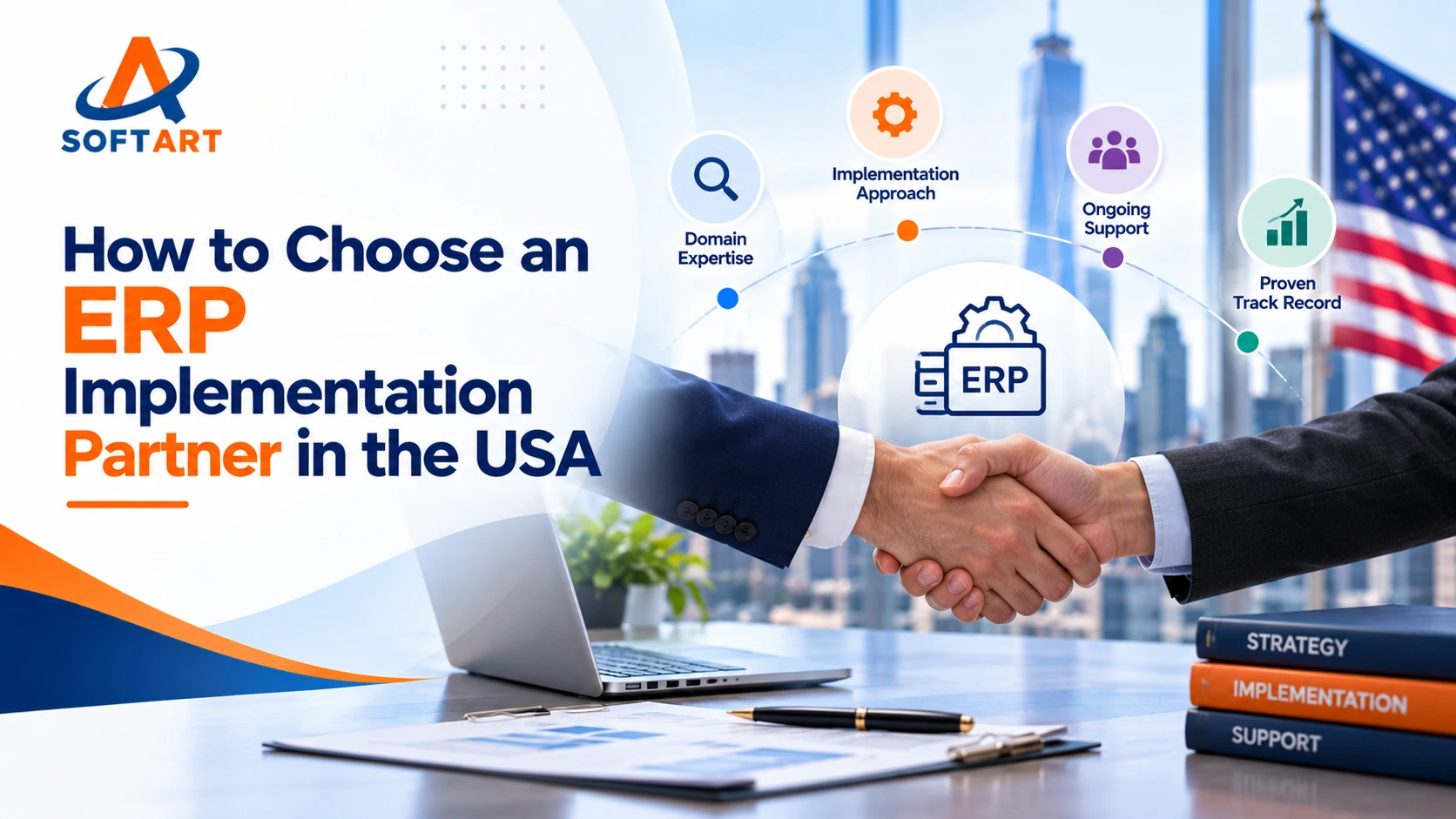
Start with the business problems you need to solve. Then evaluate platform experience, implementation methodology, migration and integration capabilities, cost transparency, relevant case studies, and ongoing support.
The best partner is one that can explain how the proposed solution will work for your business, where the risks lie, and what your team needs to do to deliver the project successfully.
That clarity is worth looking for before implementation begins.
Frequently Asked Questions
What Does an ERP Implementation Partner Do?
An ERP implementation partner helps a business plan, configure, customize, test, and deploy its ERP system. Depending on the agreed scope, the partner may also manage data migration, integrations, employee training, and post-launch support.
How Do I Choose an ERP Implementation Partner in the USA?
Evaluate the partner’s experience with your ERP platform, understanding of your business processes, implementation methodology, migration and integration capabilities, cost transparency, client references, and support arrangements.
How Much Does ERP Implementation Cost?
There is no single price for ERP implementation. Costs depend on the software, number of users, business complexity, customization, integrations, data migration, and support requirements. Request an itemized proposal based on your actual scope.
How Long Does an ERP Implementation Take?
Timelines depend on the platform, scope, data quality, integrations, customization, and availability of the client’s team. Ask prospective partners to provide a phased timeline with clear dependencies and acceptance criteria.
Which ERP Platform Should My Business Choose?
The right platform depends on your business processes, reporting needs, existing technology, budget, and plans for growth. Compare the requirements each platform can meet before committing to a product or implementation partner.