ERP pricing still catches buyers off guard because the software quote is rarely the full number. Many businesses budget for licenses first, then discover later that implementation, data migration, training, integrations, support, and internal effort can change the total by a wide margin. That is where procurement teams, finance leaders, and operations heads start asking the real question.
Here is the direct answer. ERP Software Cost in 2026 depends on far more than the base subscription. The real number usually includes software, services, data work, training, support, infrastructure, and hidden internal costs over several years. Oracle, NetSuite, and other major vendors all frame ERP pricing around total cost of ownership rather than license fees alone.
At SoftArt, we help businesses turn vendor quotes into realistic budgets by looking at what the system will actually cost to implement, run, and support, not just what it costs to buy.
What Should Be Included In ERP Software Cost In 2026?
A realistic ERP budget should include both direct and indirect costs. NetSuite’s current pricing guidance says buyers need to look beyond initial licensing and include deployment, training, ongoing operations, and business interruption or transition-related costs.
Here is the practical breakdown:
| Cost Area | What It Usually Includes |
|---|---|
| Software | Base subscription or license, user licenses, add-on modules |
| Implementation | Consulting, configuration, project management, testing |
| Data Work | Migration, cleansing, mapping, validation |
| Integrations | CRM, ecommerce, payroll, warehouse, BI, APIs |
| Training | Role-based training, onboarding, documentation |
| Support | Ongoing help, optimisation, maintenance |
| Infrastructure | Hosting and environments where applicable |
| Internal Cost | Team time, change management, process redesign |
This is the real starting point for understanding ERP Software Cost in 2026.
Why Is The Software Quote Alone Not Enough?
Because software pricing only tells you what the vendor charges for access. It does not tell you what it will cost to deploy the ERP properly, connect it to other systems, train users, or keep it working well over time.
NetSuite’s pricing and TCO guidance is clear on this point. Buyers should evaluate total cost of ownership across multiple years, not just the initial purchase or first subscription figure.
That means a cheap-looking quote can still become an expensive project if the rollout is complex.
How Do You Accurately Calculate Total ERP Costs?
The cleanest way is to separate costs into one-time and recurring buckets.
A practical formula looks like this:
Total ERP Cost = Software + Implementation + Data Migration + Integrations + Training + Support + Infrastructure + Internal Business Cost
You can also view it in three layers:
- Year 1 cost for software, implementation, migration, integrations, and go-live
- Annual recurring cost for subscriptions, support, and optimisation
- 3-year or 5-year TCO for a fair long-term comparison
NetSuite recommends exactly this kind of total cost of ownership view rather than a license-only view.
What Usually Drives ERP Implementation Cost The Most?
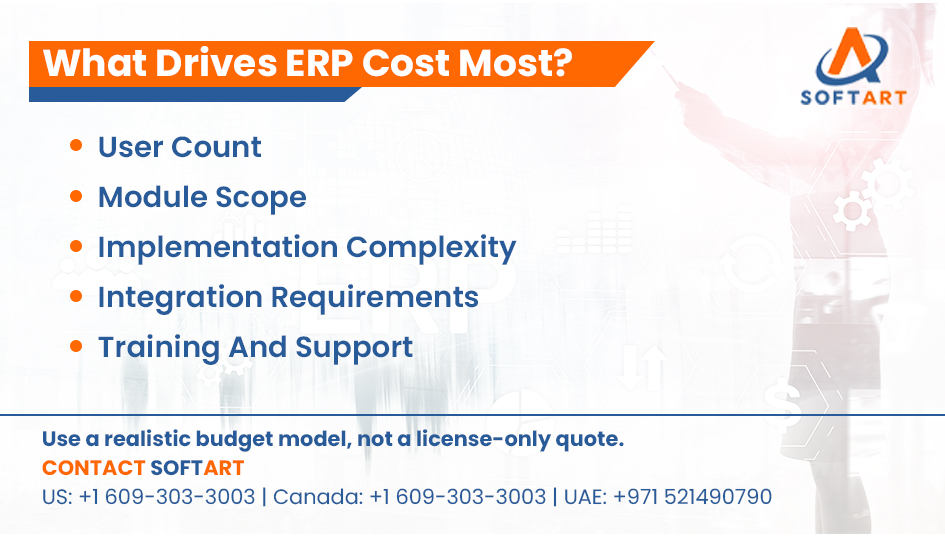
The biggest driver of ERP implementation cost is complexity, not just vendor choice. NetSuite’s implementation cost guidance says pricing is shaped by deployment model, scope, customisation, integrations, available resources, and business requirements.
The main cost drivers are:
- Number of Users
- Number of Legal Entities or Business Units
- Modules Required
- Data Migration Difficulty
- Customisation Level
- Integration Scope
- Training Needs
- Phased Rollout Structure
If two businesses buy the same ERP but one has manufacturing, multi-entity finance, and custom integrations, the project cost will usually be much higher for that business.
How Does ERP Manufacturing Software Change The Pricing Model?
ERP manufacturing software usually raises both software scope and implementation effort because it adds more operational layers. Oracle’s ERP module guidance and ERP definitions both point to manufacturing, supply chain, inventory, procurement, and related modules as major parts of ERP scope.
Manufacturing-driven ERP pricing often increases because of:
- bill of materials setup
- production planning
- shop floor or plant processes
- quality controls
- inventory traceability
- supply chain coordination
- demand and replenishment logic
This matters because a finance-first ERP project and a manufacturing ERP project should never be budgeted the same way.
What Should Buyers Expect From Oracle ERP Cloud Pricing?
The most important thing to know about oracle ERP cloud pricing is that Oracle does not generally publish simple public line-item application pricing for every ERP module the way a retail SaaS product might. Oracle’s public pricing pages focus more on Oracle Cloud Infrastructure pricing and cost estimation tools, while Oracle’s ERP application pages focus on product capabilities rather than fixed public ERP package prices.
In practical terms, buyers should expect Oracle ERP cloud pricing to vary based on:
- selected modules
- user scope
- deployment scale
- contract structure
- implementation complexity
- industry and process requirements
So when someone asks for a single fixed Oracle ERP number, the honest answer is that Oracle ERP Cloud pricing is usually quote-based and scope-dependent, not a simple public catalog figure.
How Should You Compare ERP Options Fairly?
The fairest comparison is to use the same budgeting structure across every platform. Do not compare one vendor’s subscription quote with another vendor’s full project estimate.
Use the same checklist for each ERP option:
| Comparison Area | What To Compare |
|---|---|
| Software | Base price, user pricing, modules |
| Services | Implementation, consulting, testing |
| Data | Migration, cleansing, validation |
| Integration | Third-party systems, APIs, tools |
| Training | User onboarding and enablement |
| Ongoing Cost | Support, maintenance, optimisation |
| Long-Term View | 3-year or 5-year TCO |
NetSuite’s ERP readiness guidance also supports this broader evaluation model, including TCO, support, integration, customisation, training, and roadmap fit.
When Should You Use A Calculator And When Should You Ask For A Tailored Estimate?
A calculator is best early. A tailored estimate is best before approval.
Use a cost calculator when you need:
- early budgeting
- vendor comparison
- internal shortlisting
- rough TCO modelling
Ask for a tailored estimate when you need:
- board or finance approval
- detailed implementation scope
- multi-entity budgeting
- manufacturing or supply chain complexity
- final project planning
That distinction matters because early-stage budgeting and final commercial approval are not the same exercise. NetSuite’s implementation and pricing guidance both reinforce the need to budget based on scope and long-term ownership, not just an early quote.
What Budgeting Mistakes Cause ERP Projects To Go Over Plan?
The most common mistake is treating ERP price like software price only. NetSuite’s pricing guidance specifically warns that ongoing and indirect costs are often overlooked.
Other common mistakes include:
- underestimating migration effort
- ignoring training costs
- missing integration scope
- not budgeting internal team time
- underpricing support after go-live
- assuming manufacturing complexity will fit a finance-only budget
These are exactly the mistakes that distort ERP implementation cost planning.
Get Expert Help From SoftArt To Budget ERP Properly
The real pricing question is not “What is the quote?” It is “What will this ERP actually cost us to implement, run, and support over time?” That is the only useful way to judge ERP Software Cost in 2026.
At SoftArt, we help businesses break down ERP budgets into practical cost layers, compare platforms fairly, and translate vendor pricing into a realistic ownership model. Whether you are estimating ERP implementation cost, reviewing ERP manufacturing software scope, or trying to understand oracle ERP cloud pricing in a more practical way, we can help you build a clearer budget before the project starts.
Contact SoftArt
- Email: info@softart.co
- US: +1 609-303-3003 | Canada: +1 609-303-3003 | UAE: +971 521490790
FAQs
How Do You Calculate ERP Software Cost In 2026?
You calculate it by combining software, implementation, migration, integrations, training, support, infrastructure, and internal business cost over multiple years. Major ERP pricing guidance now frames this as total cost of ownership, not just license price.
What Is Usually Included In ERP Implementation Cost?
ERP implementation cost usually includes consulting, configuration, testing, project management, migration work, training, and sometimes integration setup. The total changes based on complexity, deployment model, and scope.
Does ERP Manufacturing Software Cost More Than A Finance-Only ERP Setup?
Usually yes. Manufacturing ERP projects often involve additional process complexity, such as production, inventory, supply chain, and operational controls, which typically increase both scope and implementation effort.
Is Oracle ERP Cloud Pricing Publicly Fixed?
Not usually in a simple catalog format. Oracle’s public pricing materials focus more on cloud infrastructure pricing and estimation tools, while ERP application pricing is generally more scope-based and quote-driven.
Should I Compare ERP Vendors By Year 1 Cost Or Total Cost Of Ownership?
Use both, but make the final decision using total cost of ownership. Year 1 helps with immediate budgeting, while TCO shows the real financial impact across the life of the ERP.