Many businesses already use NetSuite for finance, operations, inventory, and reporting, but now they want to know what comes next. They are hearing about AI, natural language search, smarter workflows, and a new user experience, but the details online are still scattered. That creates confusion, especially for businesses in the UAE that want to know what NetSuite Next actually is, when it was introduced, and when it will be available locally.
Here is the direct answer. NetSuite Next Features are Oracle NetSuite’s next-generation AI-led capabilities built into the NetSuite platform. They focus on natural language interaction, agentic workflows, interactive workspaces, and a redesigned interface. The expected NetSuite Next Benefits include faster decisions, less manual work, and a more intuitive ERP experience. At SoftArt, we help businesses turn these platform changes into practical rollout decisions, especially when they need the right netsuite support services or guidance from experienced netsuite ERP implementation partners.
Read on to understand what NetSuite Next includes, when it was introduced, and what UAE businesses should expect next.
What Is NetSuite Next?
NetSuite Next is not a separate ERP product. It is Oracle NetSuite’s next-generation direction for the existing platform, with AI built into how users search, analyse, navigate, and act inside the system. Oracle describes it as the future of NetSuite and positions it around being smarter, more collaborative, and more intuitive.
To make this simpler, NetSuite Next is:
- An AI-led evolution of the existing NetSuite platform
- A new way to search, analyse, and act inside ERP
- A broader product direction, not just one feature release
- Built into NetSuite, not a separate system to migrate to
That matters because businesses evaluating NetSuite Next Features should think beyond interface changes. This is really about how ERP users interact with data and decisions inside NetSuite.
When Was NetSuite Next Introduced?
NetSuite Next was formally unveiled by Oracle NetSuite in October 2025. Oracle then announced it for the UAE market in February 2026. Oracle also said some capabilities would be available first in North America within the following 12 months, which means rollout is phased rather than instant for every region and customer.
| Milestone | What Happened |
|---|---|
| October 7, 2025 | Oracle NetSuite formally unveiled NetSuite Next globally |
| February 10, 2026 | Oracle announced NetSuite Next for the UAE market at SuiteConnect Dubai |
| Following rollout period | Additional capabilities continue to roll out in phases |
This timeline is important because UAE businesses should not assume every capability becomes active at once. Availability depends on Oracle’s release path and the customer environment.
What Are The Main NetSuite Next Features?
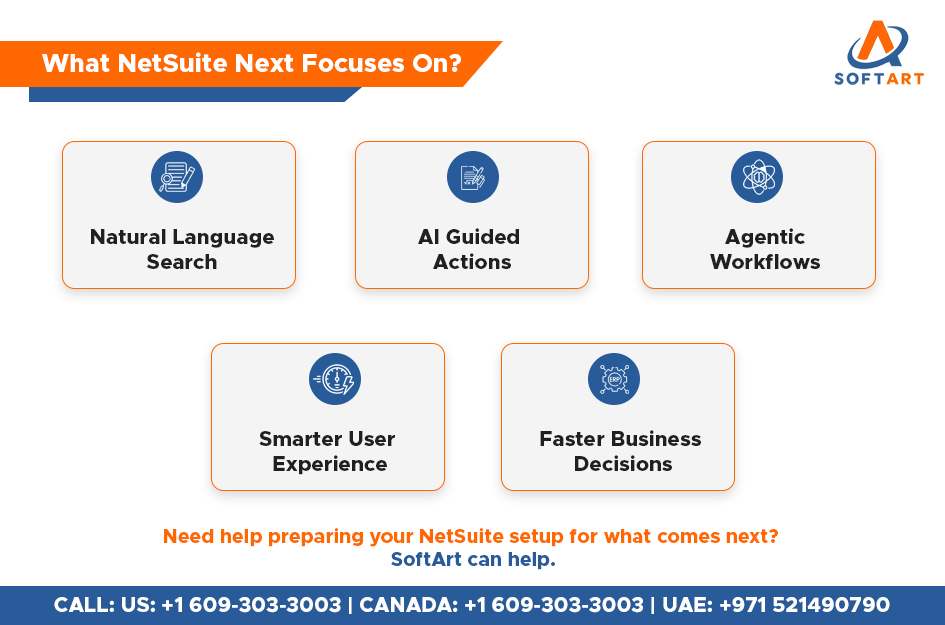
The core NetSuite Next Features are built around AI-supported work, easier navigation, and more intelligent action inside ERP. Oracle highlights several areas that define the NetSuite Next experience.
Ask Oracle
Ask Oracle is the central experience inside NetSuite Next. Oracle describes it as a natural language assistant that lets users search, navigate, analyse, and act across the NetSuite dataset using their own words. It can return context-aware answers, visualisations, interactive content, and reasoning that explains the response.
Agentic Workflows
Oracle says users can launch agentic workflows directly through Ask Oracle, and agents can also work behind the scenes. These agents can analyse options, propose actions, and support repetitive or complex work while still staying within business controls.
Interactive Canvases
NetSuite Next includes collaborative canvases where users can prepare summaries, comparisons, plans, visualisations, and analysis in one shared workspace. This makes ERP outputs easier to discuss and use for decisions.
Redwood-Based Interface
Oracle says the new interface is built on the Oracle Redwood Design System. It includes reimagined forms and record lists, smart filters and search, infinite scrolling, and reports that are easier to read and act on.
Trust And Control Built Into AI
Oracle also highlights transparency, trust, and control. It says Ask Oracle cites data sources, allows answer validation, and keeps agent actions inside existing roles, permissions, and approval flows.
What Are The NetSuite Next Benefits For Businesses?
The biggest NetSuite Next Benefits come from making ERP easier to use while making it more intelligent. Instead of asking users to search through menus and reports manually, NetSuite Next is designed to bring answers and actions closer to the work itself.
The practical benefits include:
- Faster access to information – Users can ask questions in natural language instead of hunting through menus and saved searches.
- Less manual effort – Agentic workflows and AI-supported interactions reduce repetitive work and speed up low-value tasks.
- Better decision support – Context-aware answers, analysis, and visualisations make it easier for users to understand what is happening and what to do next.
- A more usable ERP experience – The redesigned interface is intended to make transactions, lists, and reports faster and easier to work through.
- Stronger adoption potential – When ERP is easier to search, navigate, and use, non-technical teams are more likely to engage with it consistently. This is an inference based on Oracle’s focus on usability and collaboration.
How Is NetSuite Next Different From A Regular NetSuite Update?
A regular NetSuite update usually adds feature improvements, fixes, and enhancements tied to the release cycle. NetSuite Next is broader than that. Oracle is presenting it as a strategic platform direction with AI at the center of the user experience.
| Regular NetSuite Update | NetSuite Next |
|---|---|
| Adds feature improvements and fixes | Represents a broader product direction |
| Usually tied to release cycles | Focuses on AI-led ERP interaction |
| Improves existing workflows | Changes how users search, analyse, and act |
| Incremental in nature | Strategic shift in usability and collaboration |
Another practical difference is that Oracle says customers do not need a separate migration to switch to NetSuite Next. It says the move can happen without data migration or disruption to customisations.
When Will NetSuite Next Be Available In UAE?
The most accurate answer is that NetSuite Next was announced for the UAE market on February 10, 2026, but rollout should be understood in phases. Oracle had already said in October 2025 that some capabilities would become available initially for customers in North America within the next 12 months, so businesses should expect staged availability rather than a single global activation date.
For UAE businesses, the right way to think about availability is:
- The UAE market announcement has already happened
- The product direction is live
- Capabilities may roll out in stages
- Actual availability depends on the customer setup and Oracle release path
That is why businesses should review their current NetSuite environment before assuming every NetSuite Next capability is already active.
Why Does This Matter For UAE Businesses Specifically?
This matters in the UAE because many businesses operate across branches, legal entities, and fast-moving finance and operations workflows. A more intelligent ERP experience can improve visibility, speed up reporting, and reduce manual dependency across teams. Oracle’s UAE announcement says NetSuite Next is intended to help customers increase efficiency, expand insights, and drive success.
For UAE businesses, the relevance is strongest in areas like:
- Better visibility across entities
- Faster finance and management reporting
- Less friction in day-to-day ERP use
- More practical AI inside real workflows
- Stronger support for growth and scale
The value, however, still depends on the quality of the underlying ERP setup. A poorly structured system will not get the same benefit from AI-driven features as a well-designed one. This last point is an implementation inference grounded in how AI depends on existing data, workflow, and controls.
When Do Netsuite Support Services Become Important For NetSuite Next?
netsuite support services become more important when businesses want to use new platform capabilities without disrupting what already works. New features only create value when reporting, permissions, workflows, and user behaviour are aligned properly. SoftArt positions its NetSuite support around continuous optimisation, support, and maintenance after the system is live.
Support becomes especially important when a business needs to:
- Adjust workflows after new features are introduced
- Refine dashboards and reports
- Keep permissions and controls clean
- Improve adoption after release changes
- Resolve issues that appear in real usage, not just at setup
That is why support should be seen as part of ongoing ERP maturity, not just as a post-go-live help desk. This is an inference supported by SoftArt’s positioning around optimisation and maintenance.
Why Do Netsuite ERP Implementation Partners Matter For NetSuite Next Adoption?
Strong netsuite ERP implementation partners matter because advanced platform capabilities work best when the ERP foundation is already clean, scalable, and well governed. SoftArt positions its implementation services around structured rollout, process alignment, and long-term support, which is directly relevant when businesses want to prepare for future product capabilities.
Implementation partners help by:
- Designing scalable workflows early
- Keeping reporting logic clean
- Aligning permissions and approvals properly
- Planning integrations without future friction
- Supporting adoption after rollout
In simple terms, businesses should not evaluate NetSuite Next only as a feature story. They should also ask whether their ERP setup is ready to use those features well.
Get Expert Help From SoftArt To Prepare For NetSuite Next
Understanding NetSuite Next Features is useful, but getting real value from them depends on the quality of your ERP setup, reporting logic, permissions, and integrations. The same applies to the expected NetSuite Next Benefits. They are strongest when the system already reflects how your business actually works.
At SoftArt, we help businesses plan NetSuite more clearly from the start and support them as the platform evolves. SoftArt says it offers consulting, migrations, implementations, and 24×7 support, backed by 20 years of ERP experience. That makes it relevant for businesses looking for structured netsuite support services or evaluating reliable netsuite ERP implementation partners for the next stage of NetSuite.
Call SoftArt: US: +1 609-303-3003 | CANADA: +1 609-303-3003 | UAE: +971 521490790
Email: connect@softart.co
FAQs
What Is NetSuite Next In Simple Terms?
NetSuite Next is Oracle NetSuite’s next-generation AI-led experience inside the existing NetSuite platform. It adds capabilities such as natural language search, conversational assistance, agentic workflows, and a more intuitive interface.
When Was NetSuite Next Introduced?
Oracle NetSuite formally unveiled NetSuite Next in October 2025. Oracle then announced it for the UAE market on February 10, 2026.
Will NetSuite Next Be Available In UAE?
Yes. Oracle announced NetSuite Next for the UAE market in February 2026. Availability should still be understood as phased, because Oracle also said related rollout would happen over time.
What Are The Main NetSuite Next Benefits?
The main benefits include easier navigation, faster analysis, reduced manual work, better collaboration, and AI-guided actions inside ERP. Oracle also highlights speed, trust, adaptability, and a more intuitive user experience.
Do I Need Netsuite Support Services To Use NetSuite Next Well?
In many cases, yes. Businesses often need help aligning workflows, reporting, permissions, and user adoption so that new capabilities produce real business value. SoftArt positions support around continuous optimisation and maintenance after go-live.
Why Should I Work With Netsuite ERP Implementation Partners Before Adopting New Features?
Because advanced capabilities work best when your ERP design is already clean and scalable. Strong partners help with implementation structure, process alignment, and ongoing optimisation so new features do not sit unused