Many businesses compare ERP systems based only on license pricing. That approach often leads to wrong decisions. The real comparison should be based on total cost over time, not just the starting price.
Here is the direct answer. In a Business Central vs NetSuite comparison, Business Central usually has a lower entry cost and more predictable pricing. NetSuite often has a higher upfront investment but can deliver stronger value for complex, fast-growing, or multi-entity businesses over a 3-year period.
At SoftArt, we help businesses evaluate ERP platforms based on real cost, implementation effort, and long-term scalability. From selection to rollout and support, our team ensures your ERP decision aligns with your growth plans.
This guide explains how total cost of ownership works, what drives cost differences, and how to choose the right ERP based on your business needs.
What Does 3-Year Total Cost Of Ownership Mean In ERP?
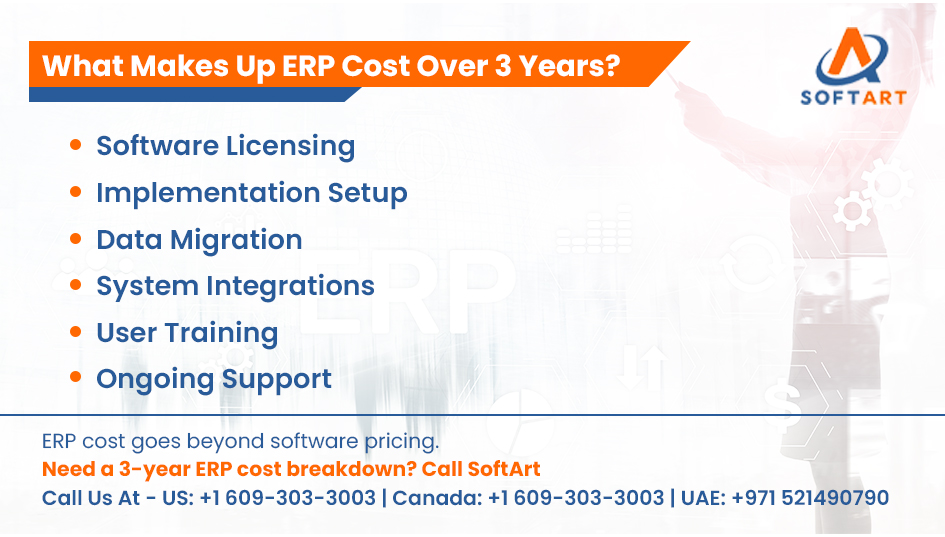
Total cost of ownership means the complete cost of using an ERP system over a defined period, not just the purchase price. For a 3-year ERP comparison, TCO includes:
- Software licensing
- Implementation cost
- Data migration
- System integrations
- User training
- Ongoing support
- Internal team effort
- System optimisation
This is the only practical way to compare ERP systems accurately.
How Do Business Central And NetSuite Pricing Models Differ?
The core difference in Business Central vs NetSuite pricing comes from how each platform is structured.
| Area | Business Central | NetSuite |
|---|---|---|
| Pricing Model | Fixed per-user pricing | Quote-based pricing |
| Cost Visibility | Transparent | Customised per project |
| Entry Cost | Lower | Higher |
| Scalability Cost | Gradual | Increases with modules and scope |
| Best Fit | SMB and Microsoft ecosystem | Growing and complex businesses |
Business Central pricing is straightforward and easier to estimate early. NetSuite pricing is more flexible but depends heavily on scope and configuration.
What Is The 3-Year Cost Pattern For Business Central?
Business Central usually follows a predictable cost structure over three years. Key cost components include:
- Per-user licensing
- Implementation services
- Add-ons and integrations
- Training and onboarding
- Ongoing support
The advantage is pricing clarity. Businesses can estimate long-term cost with fewer surprises. However, additional integrations and customisations can increase cost over time.
For companies working with a dynamics 365 business central consulting service USA, structured implementation and integration planning can keep long-term cost stable.
What Is The 3-Year Cost Pattern For NetSuite?
NetSuite follows a more flexible and scalable pricing model. Cost depends on modules, users, integrations, and business complexity. Over three years, the cost typically includes:
- Platform licensing
- User licenses
- Module expansion
- Implementation cost
- Integration setup
- Data migration
- Continuous optimisation
- netsuite support services
This is where netsuite support services become important. NetSuite is often used as a long-term ERP platform, and ongoing support ensures system performance, reporting accuracy, and user adoption.
Which ERP Is Better For Small Businesses Over 3 Years?
For small businesses, cost predictability and simplicity are important. Business Central is often a good fit for:
- Smaller teams
- Basic finance and operations
- Microsoft-based environments
- Limited integration needs
However, netsuite for small business can be a strong option when growth is expected. It is especially useful when businesses need:
- Multi-location operations
- Inventory and supply chain management
- Ecommerce integration
- Scalable reporting
The decision depends on growth plans, not just current size.
How Do Implementation Costs Compare Between Business Central And NetSuite?
Implementation cost depends more on business complexity than the ERP system itself. Both platforms require:
- Process mapping
- System configuration
- Data migration
- Integration setup
- Testing
- User training
NetSuite implementations may involve higher effort when multiple entities, advanced workflows, or integrations are involved. Business Central implementations are often simpler but can still become complex depending on scope.
What Hidden Costs Should Be Included In A 3-Year ERP Budget?
Many ERP budgets fail because hidden costs are not planned. Common hidden costs include:
- Data cleanup and restructuring
- Additional reports and dashboards
- Integration updates
- Workflow changes
- Extended training
- Support and maintenance
- Internal resource time
- Post-go-live optimisation
These costs directly affect the 3-year TCO.
When Should You Choose Business Central Over NetSuite?
Choose Business Central when:
- You need lower upfront cost
- Your processes are relatively simple
- You are already using Microsoft tools
- You want predictable pricing
- You need a faster implementation
Working with a dynamics 365 business central consulting service USA can help ensure smooth deployment and integration.
When Should You Choose NetSuite Over Business Central?
Choose NetSuite when:
- Your business is scaling quickly
- You operate across multiple entities or locations
- You need advanced inventory or supply chain management
- You require deeper reporting and analytics
- You need a cloud-native ERP for long-term growth
This is where netsuite for small business becomes relevant for companies planning expansion early.
Get Expert Help From SoftArt To Compare ERP Costs
Choosing between Business Central vs NetSuite requires more than comparing pricing. The right decision depends on implementation scope, integrations, business complexity, and long-term goals.
At SoftArt, we help businesses evaluate ERP systems based on real 3-year cost, not just software pricing. From implementation planning to integration and netsuite support services, we ensure your ERP delivers long-term value.
Contact SoftArt
Email: info@softart.co
Call Us At – US: +1 609-303-3003 | Canada: +1 609-303-3003 | UAE: +971 521490790
FAQs
Which Is Cheaper Over 3 Years, Business Central Or NetSuite?
Business Central is usually cheaper at the start, but NetSuite can deliver better value for complex or growing businesses over time.
Is NetSuite Suitable For Small Businesses?
Yes. netsuite for small business works well when the business expects growth, multiple locations, or advanced operations.
What Should Be Included In ERP TCO?
TCO should include licensing, implementation, migration, integrations, training, support, and internal effort.
Why Do NetSuite Support Services Affect Long-Term Cost?
Ongoing support ensures system performance, updates, reporting accuracy, and user adoption, which directly impacts ROI.
When Should I Choose Business Central Instead Of NetSuite?
Choose Business Central when your needs are simple, your budget is limited, and you prefer predictable pricing.