The UAE is moving toward mandatory structured e-invoicing, and the shift is much bigger than replacing PDFs with digital invoices. Businesses will soon need compliant XML invoice formats, near real-time reporting, Accredited Service Provider connectivity, and audit-ready storage aligned with the Federal Tax Authority framework. For many organisations, this creates pressure around ERP readiness, integrations, invoice workflows, and compliance timelines.
Here is the direct answer. The UAE e invoicing mandate follows a Decentralized Continuous Transaction Control and Exchange model based on the 5-Corner Peppol framework. Microsoft has already introduced localisation and compliance support through Dynamics 365 and Globalization Studio to help businesses automate invoice validation, XML generation, reporting, and ASP connectivity. At SoftArt, we help businesses prepare Dynamics 365 environments for compliant rollout with structured implementation, integration planning, and long-term support.
Read on to understand the UAE e-invoicing timeline, technical requirements, Dynamics 365 readiness, and what businesses should do before mandatory enforcement begins.
What Is The UAE E-Invoicing Mandate?
The UAE e invoicing mandate is the country’s move toward mandatory structured electronic invoicing under the Federal Tax Authority framework.
Instead of traditional PDFs or manually shared invoices, businesses will need to exchange invoices using structured XML formats through an approved digital framework. The UAE has adopted a Decentralized Continuous Transaction Control and Exchange model, commonly called the 5-Corner Peppol model.
This framework is designed to improve:
- Tax transparency
- Invoice authenticity
- Reporting accuracy
- Fraud prevention
- Real-time transaction visibility
For businesses, this means invoicing processes must become system-driven, compliant, and digitally connected.
What Is The Official UAE E-Invoicing Timeline For 2026–2027?
As of early 2026, the UAE Federal Tax Authority has formalised the implementation roadmap for mandatory e-invoicing. The rollout is phased based on business category and annual revenue.
| Phase | Taxpayer Category | ASP Appointment Deadline | Mandatory Go-Live |
|---|---|---|---|
| Pilot Phase | Invited and voluntary businesses | June 2026 | July 1, 2026 |
| Wave 1 | Revenue ≥ AED 50 Million | July 31, 2026 | January 1, 2027 |
| Wave 2 | Revenue < AED 50 Million | March 31, 2027 | July 1, 2027 |
| Government Entities | UAE Government Organisations | March 31, 2027 | October 1, 2027 |
Businesses should note that non-compliance may lead to administrative penalties, including recurring fines for failing to appoint an Accredited Service Provider or missing implementation timelines.
This is why many organisations are already reviewing ERP readiness and integration planning before enforcement begins.
Why Is The UAE Moving To A Peppol-Based Model?
The UAE framework is based on the Peppol interoperability model because it allows secure and standardised invoice exchange between businesses, service providers, and tax authorities.
Under this structure:
- Businesses exchange invoices electronically
- Accredited Service Providers validate and route invoices
- Structured XML data flows through approved networks
- Reporting happens in near real time
This creates a more standardised and auditable invoicing ecosystem compared to disconnected PDF-based processes.
What Technical Changes Will Businesses Need To Make?
The UAE mandate requires more than digital invoice sharing. Businesses will need ERP systems capable of generating structured XML invoice data aligned with PINT AE specifications.
Key Technical Requirements Include
- Structured PINT AE XML invoice generation
- Tax Identification Number validation
- Standardised invoice classification codes
- Mandatory tax and address fields
- Near real-time invoice reporting
- Secure invoice exchange through ASPs
- Audit-ready invoice storage and retrieval
The framework is expected to require more than 50 mandatory invoice fields depending on transaction type and compliance category.
Businesses relying on spreadsheets, manual approvals, or disconnected accounting systems may struggle to meet these requirements without ERP modernisation.
How Does Dynamics 365 Support UAE E-Invoicing Compliance?
Microsoft has introduced UAE-focused localisation support through Dynamics 365 and Globalization Studio as part of the 2026 Release Wave 1 roadmap.
This allows businesses to support e invoice compliance UAE requirements without depending heavily on custom coding.
How Dynamics 365 Supports Compliance?
| Compliance Requirement | Dynamics 365 Capability |
|---|---|
| Structured XML generation | Electronic Reporting maps ERP transactions into PINT AE XML |
| Invoice validation | Built-in validation workflows reduce compliance errors |
| ASP connectivity | APIs connect Dynamics 365 with Accredited Service Providers |
| Real-time status tracking | Users can monitor invoice acceptance and rejection |
| Secure document retention | Azure-backed storage supports compliance archiving |
This makes Dynamics 365 e invoicing UAE readiness much more practical for businesses already using Microsoft ERP platforms.
What Is An Accredited Service Provider And Why Does It Matter?
The UAE framework does not allow direct ERP-to-government invoice submission. Businesses must connect through Accredited Service Providers, also called ASPs.
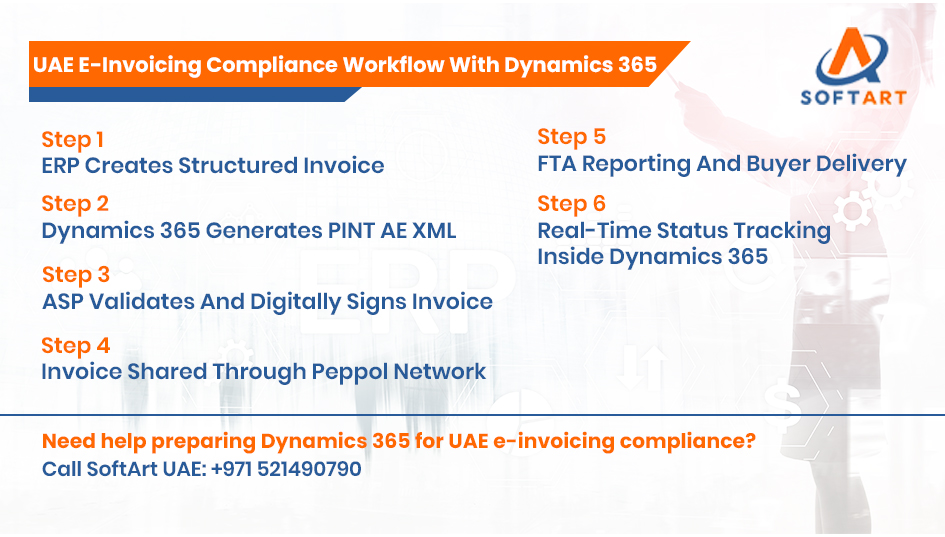
The workflow typically looks like this:
- Dynamics 365 generates the structured invoice
- The ASP validates invoice data
- Digital signatures are applied
- The invoice is exchanged through the approved network
- Reporting data is transmitted to the compliance ecosystem
Inside Dynamics 365, users can usually track statuses such as:
- Pending
- Accepted
- Rejected
- Validation failed
This is why integration planning becomes critical for compliance success.
How Does Dynamics 365 Finance And Operations UAE Support Large Enterprises?
D365 finance and operations UAE environments are especially relevant for organisations with:
- Multiple legal entities
- Shared service centres
- High invoice volumes
- Complex procurement workflows
- Multi-country operations
The platform supports automation across finance, procurement, tax reporting, and invoice validation workflows while maintaining structured governance and audit visibility.
For enterprise businesses, this reduces compliance risk while improving invoice processing speed.
Why Is Data Quality Important For E Invoice Compliance UAE?
Even strong ERP systems can fail compliance validation if underlying business data is inaccurate.
Before rollout, businesses should review:
- Customer TRNs
- Address formats
- Tax group mappings
- Invoice classifications
- Vendor master data
- Approval workflows
Poor master data can lead to rejected invoices, reporting delays, and compliance issues.
That is why implementation planning should include data cleanup before mandatory go-live phases begin.
When Should Businesses Start Preparing For UAE E-Invoicing?
Businesses should ideally begin preparation well before their enforcement phase. Early preparation helps with:
- ERP readiness assessment
- ASP selection
- Integration testing
- XML validation
- User training
- Workflow redesign
- Reporting configuration
Waiting until enforcement deadlines approach may increase project risk, implementation pressure, and operational disruption.
Why Work With A Microsoft Dynamics 365 Business Central Partner UAE?
A strong microsoft dynamics 365 business central partner UAE helps businesses prepare ERP systems for both compliance and operational continuity.
This includes:
- UAE localisation setup
- XML invoice workflow configuration
- ASP integration support
- VAT and reporting alignment
- Workflow automation
- User training and support
At SoftArt, we help businesses prepare Dynamics 365 environments for long-term compliance readiness while keeping processes scalable and upgrade-safe.
Prepare Your Dynamics 365 Environment For UAE E-Invoicing With SoftArt
The UAE e invoicing mandate is not just a finance change. It is a system, workflow, and compliance transformation that affects invoicing, reporting, integrations, and operational governance. Businesses using Dynamics 365 already have a strong foundation, but successful compliance still depends on structured implementation, clean master data, and reliable integration planning.
At SoftArt, we help businesses prepare for e invoice compliance UAE requirements through Dynamics 365 configuration, ASP integration planning, reporting setup, and post-go-live support. Whether you use Business Central or D365 finance and operations UAE environments, our team helps you move toward compliant invoicing with confidence.
- Call SoftArt UAE: +971 521490790
- Email: connect@softart.co
Frequently Asked Questions
What Is The UAE E-Invoicing Mandate?
The UAE e invoicing mandate is the Federal Tax Authority framework requiring businesses to exchange structured electronic invoices using approved digital standards instead of traditional PDF invoices.
What Is The UAE E-Invoicing Timeline For 2026–2027?
The rollout begins with pilot businesses in July 2026, followed by large businesses in January 2027, smaller businesses in July 2027, and government entities in October 2027.
How Does Dynamics 365 E Invoicing UAE Compliance Work?
Dynamics 365 supports compliant XML generation, ASP integration, invoice validation, reporting workflows, and audit-ready storage through built-in localisation and Electronic Reporting capabilities.
What Is An Accredited Service Provider In UAE E-Invoicing?
An Accredited Service Provider is an approved intermediary that validates, signs, routes, and exchanges invoices between businesses and the compliance network.
Why Is D365 Finance And Operations UAE Suitable For Compliance?
D365 finance and operations UAE environments support structured workflows, enterprise reporting, invoice automation, and scalable compliance processes for high-volume organisations.
Why Should Businesses Work With A Microsoft Dynamics 365 Business Central Partner UAE?
A microsoft dynamics 365 business central partner UAE helps businesses configure localisation, integrations, XML workflows, reporting, and compliance processes correctly before enforcement deadlines arrive.