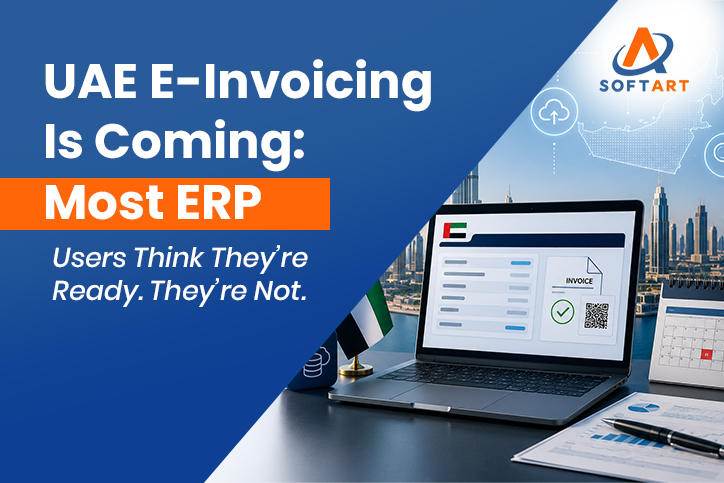
Many organisations in the UAE assume their ERP system is already ready for e-invoicing because they issue invoices digitally today. That assumption is risky. The upcoming UAE invoicing regulations are not about digital invoices; they are about structured, real-time, government-linked data exchange using strict XML standards and accredited service provider networks.
Here is the direct answer. Most ERP systems are not ready because UAE e-invoicing requires structured invoice formats, validated tax fields, real-time reporting, and integration through approved service providers. Whether a business is using Oracle ERP Cloud or another platform, readiness depends on configuration, data quality, and integration architecture. At SoftArt, we help businesses assess ERP readiness, fix compliance gaps, and prepare for structured invoicing under UAE regulations through controlled implementation and advisory support.
Read on to understand what UAE invoicing regulations actually require, where ERP systems fail, and how to prepare correctly before enforcement begins.
What Are UAE Invoicing Regulations Really Requiring?
UAE invoicing regulations are shifting from traditional invoice generation to a structured, data-driven compliance system.
Instead of sending PDFs or manually generated invoices, businesses will need to generate and transmit invoices in a structured XML format aligned with national standards and validated through approved networks.
Key requirements include:
- Structured XML invoice format (not PDF-based compliance)
- Standardised tax and transaction codes
- Near real-time invoice reporting
- Accredited Service Provider (ASP) validation
- Secure digital exchange between businesses
- Mandatory invoice data fields for tax reporting
This is a complete shift in how ERP systems handle financial transactions, not just an upgrade to invoicing formats.
Why Most ERP Users Think They Are Already Ready?
Many businesses believe ERP readiness is already achieved because:
- They issue invoices digitally
- They use cloud ERP systems
- They have automated billing workflows
- They already support VAT reporting
However, these capabilities do not automatically align with UAE invoicing regulations.
The key gap is this:
Digital invoicing is not the same as compliant structured invoicing.
ERP systems must be explicitly configured to support:
- XML-based invoice generation
- Government-approved data structures
- Real-time validation workflows
- ASP-based submission layers
Without these, systems remain partially compliant at best.
What Breaks Inside ERP Systems During UAE E-Invoicing Transition?
Even strong ERP systems can fail compliance readiness if architecture and data are not prepared correctly.
Common failure points include:
- Missing or inconsistent tax identifiers
- Poor customer master data structure
- Non-standard invoice formats
- Lack of integration with external validation systems
- Over-customised invoice workflows
- Delayed reporting processes
These issues become critical under UAE invoicing regulations because validation happens at the transaction level, not after posting.
How To Prepare ERP For UAE E-Invoicing Correctly?
Preparing ERP systems for UAE e invoicing is not a single configuration step. It is a structured readiness process across data, integration, and compliance layers.
Step 1: Clean Master Data
Ensure customer, vendor, and tax data is accurate and standardised.
- TRN validation
- Address formatting alignment
- Tax code mapping
- Legal entity consistency
Step 2: Align Invoice Structure
ERP must support structured invoice output aligned with UAE requirements.
- XML-ready invoice formats
- Standard tax classification fields
- Mandatory data element mapping
Step 3: Enable Integration Layer
ERP systems must connect with external compliance ecosystems.
- Accredited Service Provider integration
- API-based invoice exchange
- Real-time validation feedback
Step 4: Configure Reporting Controls
- Near real-time reporting setup
- Invoice status tracking
- Audit-ready document storage
Step 5: Validate End-to-End Workflow
Before go-live:
- Test invoice creation
- Validate XML output
- Confirm ASP communication
- Check rejection handling
How Oracle ERP Cloud Implementation Changes E-Invoicing Readiness?
For businesses using Oracle ERP Cloud implementation, readiness depends heavily on configuration of compliance tools and integration layers.
Oracle ERP Cloud supports structured financial workflows, but UAE compliance requires additional localisation and integration readiness.
Key focus areas include:
- Oracle Globalization Studio configuration
- XML invoice mapping setup
- External ASP connectivity
- Tax engine alignment with UAE rules
- Workflow validation and approval design
Without proper configuration, even Oracle ERP Cloud systems may not fully meet UAE invoicing regulations.
Why Oracle Cloud ERP Consulting Firms Matter?
Many organisations underestimate the complexity of compliance transformation and rely only on internal teams.
Oracle cloud ERP consulting firms play a critical role in bridging compliance gaps by ensuring:
- Proper UAE localisation setup
- Accurate invoice structure mapping
- Integration with accredited service providers
- Clean data migration and validation
- End-to-end testing of invoice workflows
This is especially important in phased compliance environments where errors can lead to rejected invoices and operational disruption.
What Happens If ERP Is Not Ready?
If ERP systems are not properly prepared for UAE invoicing regulations, businesses may face:
- Invoice rejection at validation stage
- Delayed customer billing cycles
- Compliance reporting failures
- Integration breakdowns with ASP networks
- Increased operational overhead
The risk is not theoretical; it is operational and immediate once enforcement begins.
Why SoftArt Approach Matters?
At SoftArt, we help organisations bridge the gap between ERP capability and UAE compliance reality. Our focus is not just implementation, but readiness validation, integration planning, and long-term support. We work with businesses using Oracle ERP Cloud implementation environments and other ERP systems to ensure:
- Clean compliance architecture
- Structured invoice workflows
- ASP integration readiness
- Accurate reporting alignment
- Sustainable post go-live support
This ensures ERP systems are not just functional, but compliance-ready under UAE invoicing regulations.
Prepare Your ERP Before UAE E-Invoicing Goes Live
The biggest mistake organisations make is assuming ERP systems are already compliant because they are digital. UAE invoicing regulations require structured, validated, and real-time invoice processing that most ERP systems are not configured for by default.
Understanding how to prepare ERP for UAE e invoicing early reduces risk, prevents rework, and ensures smoother transition when enforcement begins.
If your organisation is using Oracle ERP Cloud or evaluating compliance readiness, SoftArt can help you assess gaps and build a structured roadmap for implementation.
- Call SoftArt: +971 521490790
- Email: connect@softart.co
Frequently Asked Questions
Are most ERP systems ready for UAE invoicing regulations?
No. Most ERP systems support digital invoicing but not structured XML-based compliance required under UAE invoicing regulations.
How to prepare ERP for UAE e invoicing?
ERP must be configured for structured XML output, ASP integration, clean master data, and real-time reporting alignment.
Does Oracle ERP Cloud support UAE e-invoicing?
Yes, but it requires proper configuration, localisation setup, and integration through Oracle ERP Cloud implementation best practices.
Why do businesses need Oracle cloud ERP consulting firms?
They ensure ERP systems are correctly configured for compliance, integration, and data accuracy under UAE invoicing regulations.
What is the biggest risk in UAE e-invoicing readiness?
The biggest risk is assuming ERP is already compliant without validating XML structure, integration readiness, and data quality.