You’ve probably seen the phrase “certified Odoo partner” on at least a dozen websites by now. Most of them don’t explain what it means beyond a logo and a badge. That’s worth fixing before you sign an implementation contract with anyone.
SoftArt Solutions Inc. partnered with Odoo because the Odoo ERP system covers every core business function in one connected platform at a cost and implementation speed that works for real businesses, not just enterprises with 18-month rollout budgets.
As a certified Odoo partner, SoftArt delivers Odoo ERP software implementation, consulting, integrations, and post-go-live support for SMBs and mid-market businesses across the USA.
Read on to understand what the Odoo partnership requires, why we chose it over other platforms, and what it means for your implementation.
What Is an Odoo Partnership and What Does It Actually Require?
An Odoo partnership is a formal agreement where a firm meets Odoo SA’s standards for implementation quality, certified staff, and client delivery before being listed as an official Odoo partner.
This is not a reseller arrangement. Odoo does not hand out partner status to any firm willing to pay a fee. Partners are evaluated on three criteria:
- Number of new Odoo Enterprise users activated within 12 months
- Number of Odoo-certified team members employed
- Customer retention rate, tracked from Silver level upward
That last metric matters. It means Odoo is watching whether clients stay or leave after implementation.
What Are the Odoo Partner Tiers?
Odoo classifies its partners into three tiers:
| Tier | What It Reflects |
| Ready | Entry-level. Basic certification met. First implementations completed. Suited for simpler projects. |
| Silver | Established delivery record. More certified staff. Customer retention tracked. |
| Gold | Highest tier. Most projects delivered, largest certified teams, deepest process expertise. |
Odoo reports approximately 50% annual growth, according to Odoo Experience 2025. That growth rate means implementation demand is expanding faster than the partner network can absorb it. Not every firm calling itself an Odoo partner is operating at the same level.
SoftArt’s specific partner tier is available upon request. Contact SoftArt directly to confirm current partner status before your project starts.
Why Did SoftArt Choose to Partner With Odoo?
SoftArt partnered with Odoo because the Odoo ERP system covers finance, inventory, sales, CRM, manufacturing, and HR in one connected platform at a cost structure that fits how most USA SMBs actually operate.
Here’s the honest version of that decision.
SoftArt also works with Oracle NetSuite, Oracle Cloud ERP, and Microsoft Dynamics 365. None of those platforms were excluded because they aren’t good. They were evaluated alongside Odoo for what each one does best and for which business size and stage each one fits.
Odoo stood out for three practical reasons, and none of them are about marketing.
- The modular structure matches how businesses actually grow. A company doesn’t need 14 modules on day one. Odoo lets businesses start with the functions they use now and add HR, manufacturing, or ecommerce later without switching platforms or renegotiating contracts. That flexibility matters more than most ERP sales decks admit.
- The implementation speed is realistic for SMBs. A small business with three to four modules can go live in six to ten weeks with a proper partner. According to OBS Solutions’ December 2025 partner report, working with a certified Odoo partner can shorten implementation timelines by up to 30% compared to self-implementation. A partner who has done this dozens of times doesn’t have to figure out the hard parts during your project.
- The Odoo ERP software is also built for businesses that want to own their data. Odoo’s open architecture means customisations can be built, extended, or migrated. That’s a real consideration for any business planning past its first five years, not a selling point to gloss over.
What Does the Odoo ERP System Actually Cover?
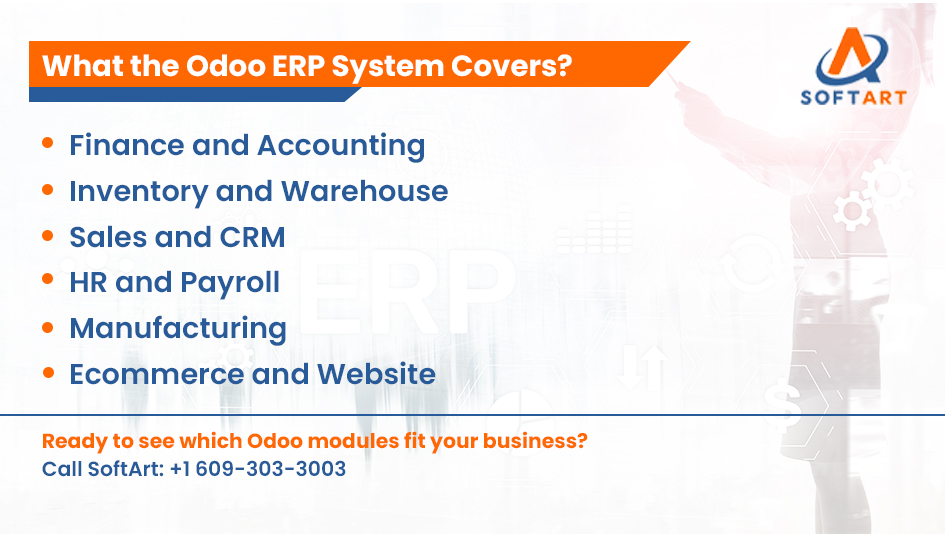
The Odoo ERP system covers accounting, inventory, sales, CRM, HR, manufacturing, ecommerce, and project management in one connected platform with 70+ apps.
For USA businesses evaluating Odoo, here’s what that looks like across the modules most commonly implemented first:
- Finance and Accounting. Chart of accounts, bank reconciliation, invoicing, tax reporting, multi-currency. Replaces standalone tools like QuickBooks or Sage.
- Inventory and Warehouse. Real-time stock tracking, purchase orders, supplier management, landed costs, multi-warehouse. Relevant for distribution and product businesses.
- Sales and CRM. Lead management, pipeline tracking, quotes, sales orders, customer portal. Connects directly to inventory and invoicing without manual data entry between tools.
- Manufacturing. Bills of materials, production orders, work centres, quality control. Built for manufacturers who need operations and finance in the same system.
- HR and Payroll. Employee records, leave management, expense reports, payroll integration. Handles the back-office layer most businesses manage in spreadsheets.
- Ecommerce. Online store connected directly to inventory and accounting. Relevant for product businesses selling direct to consumer.
Odoo comes in two editions:
- Odoo Community is free and open-source. Suited to businesses with internal technical capacity and basic requirements.
- Odoo Enterprise is the paid version. Includes full support, hosting options, advanced features, Odoo Studio, and access to the certified partner network.
Most businesses implementing Odoo for the first time choose Enterprise.
Odoo 19 was released in September 2025. Certified Odoo partners are required to align their team’s expertise with each annual release. That means the partner working on your project should already be trained on the current version, not the one from two years ago.
What Does Working With a Certified Odoo Partner Mean for Your Project?
Working with a certified Odoo partner means your implementation follows Odoo SA’s quality standards, your team has verified expertise on the current Odoo version, and your project has direct access to Odoo support that freelancers and uncertified firms cannot provide.
That distinction matters more at certain stages than others.
| Project Stage | Certified Odoo Partner | Freelancer | Going Direct to Odoo |
|---|---|---|---|
| Requirements | Documented, signed off before config starts | Varies | Limited advisory capacity |
| Configuration | Follows Odoo best practices, tested before UAT | Depends on individual skill | Standardised but less tailored |
| Data Migration | Structured extraction, cleaning, test run, validation | Often manual, higher risk | Not typically in scope |
| Integrations | Certified partner handles third-party connections | Depends on skill set | Not covered |
| UAT | Real business users test real workflows before go-live | Not always structured | Not included |
| Post Go-Live | Same team, continued support | Often project ends at go-live | Paid support tickets |
A freelancer might configure modules at a lower day rate. The gap shows up after go-live. The cost of fixing problems later is higher than what was saved upfront when:
- Data migration was not structured or validated before go-live
- Integrations were not built and tested before cutover
- Workflows went live without user sign-off during UAT
That’s not speculation. It’s a pattern SoftArt’s recovery team has seen across ERP platforms.
Working with a certified Odoo partner also means your firm has access to Odoo SA’s second-level support channel. The partner handles first-line support. Odoo SA handles bugs, platform issues, and technical escalations. That pipeline doesn’t exist for businesses working with uncertified implementers.
How Does SoftArt’s Odoo Partnership Benefit Your Business in Practice?
SoftArt’s Odoo partnership gives USA businesses access to certified Odoo ERP software implementation, cross-platform advisory, and post go-live support under one engagement.
Every SoftArt Odoo project follows eight documented stages:
- Discovery and requirements assessment
- Business requirements document
- Scope of work with client sign-off
- System configuration
- Data migration with test run and validation
- User acceptance testing
- Go-live support
- Post go-live stabilisation
Nothing moves to the next stage without sign-off from the client team. Nothing goes live without validated data and completed UAT. That structure exists because it prevents the problems that cause ERP projects to fail, not to slow things down.
What makes SoftArt’s Odoo partnership different from firms that implement only Odoo is cross-platform ERP experience.
The team has delivered 100+ ERP implementations across Odoo, Oracle NetSuite, Oracle Cloud ERP, and Microsoft Dynamics 365. That means the fit assessment at the start of an engagement is honest. If Odoo fits your business, it gets implemented correctly. If another platform is a stronger match, you’ll hear that before any contract is signed.
For USA businesses evaluating the Odoo ERP system, SoftArt’s consulting engagement covers:
- ERP fit assessment
- Module selection
- Integration planning
- Data readiness review
- Implementation scoping
All of this happens before any commitment to a full project.
Start Your Odoo ERP Project With SoftArt
SoftArt Solutions Inc. is a certified Odoo partner with 20+ years of ERP delivery experience and 100+ implementations across platforms.
SoftArt works with USA businesses across:
- Manufacturing and distribution
- Ecommerce and retail
- Hospitality and construction
- Professional services
Whether you are evaluating the Odoo ERP system for the first time, have already shortlisted Odoo and need an implementation partner, or want an honest comparison against NetSuite or Dynamics 365 before committing, SoftArt’s consulting team can help.
Book an Odoo consultation with SoftArt.
Email: info@softart.co
US: +1 609-303-3003 | Canada: +1 609-303-3003 | UAE: +971 521490790
Frequently Asked Questions
What is the difference between an Odoo partnership and going direct to Odoo?
Going direct to Odoo gives you access to Odoo’s internal team but limited customisation, integration, and post-go-live support. A certified Odoo partner handles requirements, configuration, data migration, integrations, UAT, and ongoing support as a single engagement.
How do I verify that a firm is a certified Odoo partner?
Check Odoo’s official partner directory at odoo.com/partners. Search by country and tier. Any firm listed there has met Odoo SA’s current certification requirements. If a firm isn’t listed, ask for their current partner documentation directly.
What Odoo ERP software modules should a USA business implement first?
Most USA SMBs start with accounting, inventory, and sales. These three modules replace the most common disconnected tools and deliver visible operational improvement fastest. Additional modules like HR, manufacturing, or ecommerce are added based on business priority after the core is stable.
Can a certified Odoo partner support us after go-live?
Yes. Post go-live support is a core part of a certified Odoo partner engagement. SoftArt’s post go-live support covers system stabilisation, user issues, configuration adjustments, and module additions as the business grows.
How long does an Odoo ERP system implementation take for a small business?
Small businesses implementing three to four modules typically go live in six to ten weeks. Mid-market businesses with five to eight modules and third-party integrations typically take three to five months. Timeline depends on data quality, scope, and how quickly the client team can participate in UAT.
What makes SoftArt’s Odoo partnership different from other Odoo partners?
SoftArt implements Odoo alongside Oracle NetSuite, Oracle Cloud ERP, and Microsoft Dynamics 365. That cross-platform experience means the fit assessment is honest. Firms that only implement Odoo have one answer regardless of the question. SoftArt’s answer depends on your actual business requirements.