Wholesale distribution businesses operate between customer demand and supplier availability. This creates constant pressure to maintain inventory, fulfill orders quickly, protect margins, and provide finance teams with accurate performance data.
Spreadsheets, disconnected warehouse systems, and manual reconciliation may work for a limited time. However, as a distributor adds locations, suppliers, sales channels, or product lines, these workarounds make it harder to answer critical questions:
- What inventory is available to promise?
- Which orders are delayed?
- Where is margin leaking?
- What is the actual cash position?
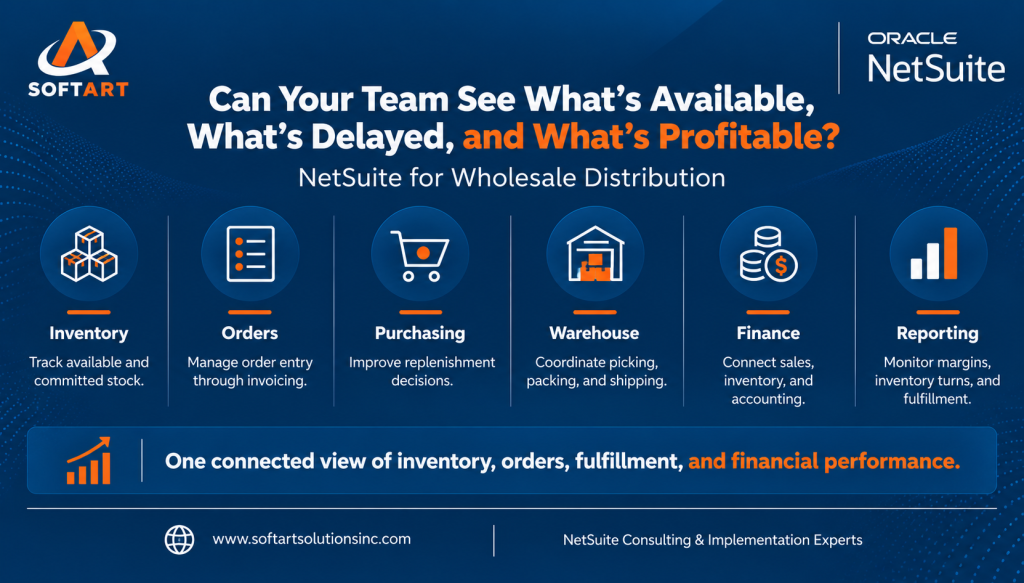
NetSuite for wholesale distribution connects financials, inventory, purchasing, sales, and fulfillment within one ERP environment, helping businesses improve operational visibility and control.
What Should a Wholesale Distribution ERP Solve?
| Business Need | What the ERP Should Provide |
|---|---|
| Inventory visibility | Available, committed, inbound, and location-level stock information |
| Order management | A consistent process from order entry through fulfillment and invoicing |
| Purchasing | Supplier lead times, replenishment, purchase orders, and receipt tracking |
| Warehouse operations | Better coordination between inventory and fulfillment |
| Financial control | Connected sales, purchasing, inventory valuation, receivables, and payables |
| Management reporting | Reliable dashboards for margin, inventory turns, service levels, and cash flow |
Why Businesses Consider NetSuite for Wholesale Distribution
1. Multi-Location Inventory Visibility
Distributors often hold inventory across multiple warehouses or facilities. NetSuite inventory management can help teams understand where stock is located, what is committed, and what is available for specific orders.
This supports better allocation decisions and reduces dependency on separate inventory spreadsheets.
2. Better Order Fulfillment Control
When sales, inventory, purchasing, and warehouse information are connected, teams can identify shortages and fulfillment exceptions earlier.
This helps customer service provide more accurate order updates while allowing operations teams to respond before delays affect customers.
3. Stronger Purchasing Decisions
Purchasing teams need visibility into demand, supplier lead times, reorder points, and vendor performance.
A connected ERP environment supports more informed replenishment decisions and helps reduce the risk of unnecessary stock or avoidable stockouts.
4. More Dependable Financial Reporting
Inventory and operational transactions directly affect financial results. Connecting sales, purchasing, inventory, and accounting reduces the need to reconcile information across separate applications.
Finance teams can work with more consistent data for inventory valuation, receivables, payables, and profitability reporting.
5. Support for Distribution Growth
A scalable wholesale distribution ERP can support new locations, products, sales channels, and operational processes without creating a separate workaround for every business requirement.
Core NetSuite Capabilities for Distributors
NetSuite can support distribution businesses through capabilities such as:
- Inventory and warehouse management
- Purchase order and vendor management
- Sales order processing and fulfillment
- Pricing, discounts, and customer-specific terms
- Lot, serial, and bin tracking where required
- Returns and credit processing
- Financial management and inventory accounting
- Role-based dashboards and reporting
- Integration with ecommerce, CRM, EDI, 3PL, and other systems
The required configuration depends on the distributor’s products, locations, fulfillment model, and customer requirements.
A Practical Wholesale Distribution Workflow
A typical distribution process may include:
- A customer order is entered through sales, ecommerce, EDI, or another channel.
- NetSuite validates customer, pricing, credit, and inventory information.
- The order is allocated to the appropriate warehouse or fulfillment location.
- Purchasing or replenishment is initiated when inventory is insufficient.
- Warehouse teams pick, pack, and ship the order.
- Shipment and invoice information is recorded and shared with the customer.
- Finance and management receive connected information about revenue, cost, inventory, and receivables.
This connected workflow helps reduce handoffs between sales, purchasing, warehouse, fulfillment, and finance teams.
Signs Your Current Systems Are Holding Back Growth
Your existing systems may need review if:
- Teams maintain separate inventory spreadsheets for different locations.
- Customer service cannot quickly confirm order status.
- Purchasing decisions depend heavily on individual employee knowledge.
- Finance spends excessive time reconciling sales, inventory, and purchasing data.
- Backorders and stockouts are discovered late.
- Warehouse teams rely on manual workarounds.
- Management reports arrive after the decision window has passed.
Implementation Priorities for Wholesale Distributors
| Priority | Implementation Focus |
|---|---|
| Master data | Clean items, customers, vendors, units of measure, locations, and pricing |
| Inventory model | Define warehouses, bins, replenishment rules, and availability logic |
| Order flow | Document order entry, allocation, fulfillment, shipment, and invoicing |
| Purchasing | Align demand planning, approvals, vendor terms, and receipt processes |
| Integrations | Prioritize ecommerce, EDI, CRM, 3PL, shipping, and payment connections |
| Reporting | Define leadership KPIs before building dashboards |
| Adoption | Train users by role and measure process adoption |
Business Outcomes to Measure
A distributor should evaluate the ERP project against measurable business outcomes, including:
- Order cycle time
- On-time shipment rate
- Inventory accuracy
- Stockout and backorder frequency
- Inventory turnover
- Gross margin by customer or product
- Days sales outstanding
- Time required to close the books
- Time spent on manual reconciliation
How SoftArt Solutions Can Support Your Journey
A successful NetSuite project is not only a software deployment. It is also a process and operating-model project.
SoftArt Solutions can help distribution businesses assess current systems, define future-state workflows, plan integrations, configure NetSuite, migrate data, train users, and provide post-go-live support.
The right NetSuite solution provider should understand warehouse operations, order exceptions, inventory accounting, customer-specific pricing, and finance reporting—not only software features.
Conclusion
NetSuite for wholesale distribution helps connect inventory, purchasing, order fulfillment, warehouse operations, and financial management within one ERP environment.
The most effective implementation is based on the distributor’s actual workflows, inventory model, trading-partner requirements, and growth plans.
If your current systems make it difficult to manage inventory, fulfill orders, or understand financial performance, contact SoftArt Solutions to discuss your NetSuite requirements.
Frequently Asked Questions
Is NetSuite suitable for wholesale distributors with multiple warehouses?
NetSuite can support multi-location distribution processes when inventory, fulfillment, master data, and reporting are designed around the business model.
Can NetSuite integrate with ecommerce and EDI?
Yes. The integration scope should be defined around the required systems, transaction types, data ownership, and exception-handling requirements.
Should a distributor replace every system at once?
Not always. A phased implementation roadmap can reduce risk, especially when warehouse, ecommerce, EDI, or legacy systems are business-critical.
What is the most important preparation step?
Document the current processes and clean the data. Poor master data and unclear ownership can create problems regardless of the ERP platform.
Explore SoftArt’s NetSuite consulting , NetSuite integration services , and NetSuite support services .