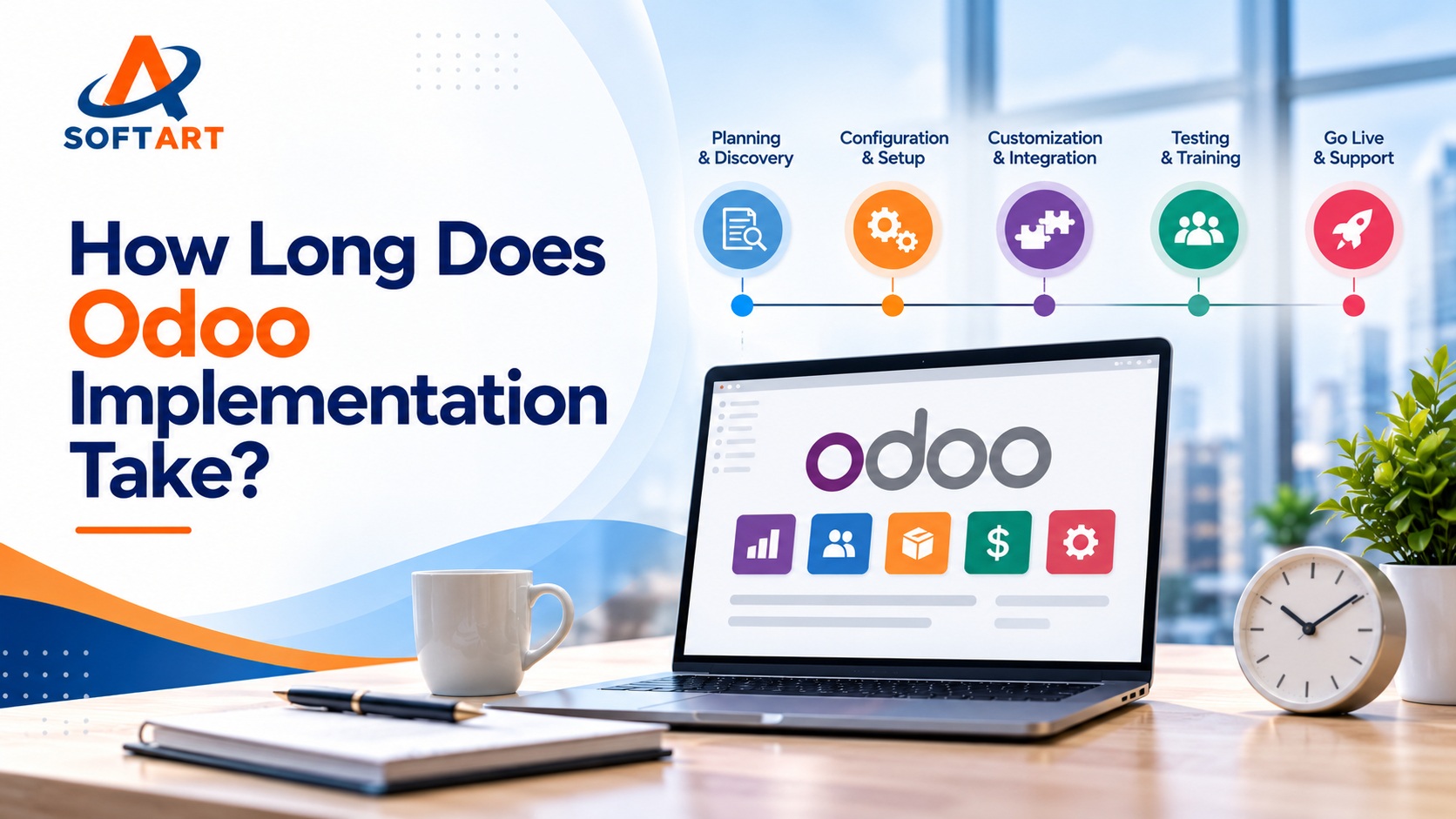
An Odoo ERP implementation typically takes 8–16 weeks to reach go-live, depending on the project’s scope and complexity. Smaller projects with clearly defined requirements may take less time, while implementations involving extensive customization, multiple integrations, or complex business processes can take several months.
For example, a distributor implementing sales, purchasing, and inventory may have a different timeline from a manufacturer managing multiple warehouses, production workflows, and external systems.
The goal is not simply to launch quickly. It is to implement Odoo in a way that supports your daily operations, keeps business data reliable, and prepares employees to use the system effectively.
1. What Is the Typical Odoo Implementation Timeline?
| Implementation type | Indicative timeline |
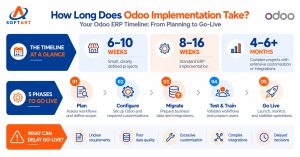
| Small, clearly defined project | 6–10 weeks |
| Standard implementation across core departments | 8–16 weeks |
| Complex implementation with extensive customization or integrations | 4–6+ months |
These are general planning estimates, not guaranteed delivery dates. Your actual Odoo implementation timeline will depend on the modules required, data readiness, integrations, and internal decision-making.
2. What Are the Main Phases of Odoo Implementation?
A structured Odoo implementation process generally includes five stages.
Phase 1: Business assessment and planning
The implementation team reviews existing workflows, identifies operational challenges, and selects the appropriate Odoo applications. Clear requirements help establish priorities and prevent unnecessary changes later.
Phase 2: Configuration and customization
Odoo is configured for your business processes, including accounting, sales, purchasing, inventory, and reporting. Custom development is considered when standard functionality cannot meet a genuine business requirement.
Phase 3: Data migration and integrations
Customer records, supplier details, products, inventory balances, and relevant financial data are prepared for migration. Integrations with payment gateways, e-commerce platforms, shipping providers, or other business applications may also be required.
Phase 4: Testing and user training
Employees test real business scenarios, validate migrated data, and learn how to perform their daily tasks in Odoo. Thorough testing helps identify issues before go-live.
Phase 5: Go-live and ongoing support
The business transitions to Odoo after critical issues are addressed and users are ready. Post-launch support helps resolve initial problems and stabilize workflows.
These phases can overlap, and complex projects may need additional time at each stage.
3. What Can Delay an Odoo ERP Implementation?
Even a well-planned project can encounter delays. Common causes include:
- Unclear requirements: New requests expand the original scope.
- Poor data quality: Duplicate or incomplete records require additional cleanup.
- Excessive customization: Recreating every legacy process increases development and testing.
- Complex integrations: Connecting external systems introduces technical dependencies.
- Delayed decisions: Approvals and feedback arrive later than planned.
- Insufficient training: Employees are not ready to adopt new workflows.
To reduce delays, define priorities early, prepare data before migration, assign an internal project owner, and involve employees in testing.
A phased Odoo ERP deployment can also help businesses launch essential workflows first and introduce additional applications as their needs evolve.
4. How Do You Choose the Right Odoo Implementation Partner?
The right Odoo implementation partner should understand your business processes, not just the software. Look for experience in module selection, workflow configuration, data migration, integrations, customization, and post-implementation support.
SoftArt Solutions brings 100+ ERP deployments and certified Odoo consultants to its ERP services. Its typical Odoo implementation timeline is 8–16 weeks, depending on project requirements and complexity.
SoftArt supports businesses with Odoo implementation, business-specific configuration, integrations, and ongoing assistance. Explore our Odoo ERP implementation services to learn more.
5. Can You Start Small With Odoo?
Not every business needs a full ERP rollout from day one. Starting with one application can help you address an immediate business need before expanding to other departments.
It can help reduce upfront investment, simplify adoption, and give your team time to adapt before expanding to other departments.
We offer an Odoo One App Free implementation package for $5,000, combining Odoo’s One App Free plan—which supports unlimited users on one application hosted on Odoo Online—with implementation and setup support.
As your business grows, you can add applications for accounting, CRM, sales, inventory, manufacturing, project management, and e-commerce. Depending on the application and version, Odoo’s AI capabilities can also support tasks such as invoice scanning, bank reconciliation, content suggestions, and ticket routing.
The business advantage: Start by solving a priority problem, improve process visibility, and expand your ERP capabilities as operational needs evolve.
6. How Can You Find the Right Odoo Setup for Your Business?
Before committing to an implementation timeline, identify the workflows you want to improve, the systems that need to connect, the data that must be migrated, and the departments that will use Odoo.
SoftArt Solutions offers a free 60-minute Odoo Business Fit Session using your own data. This session gives your team an opportunity to explore how Odoo could support your operations and evaluate whether the platform fits your requirements.
Schedule your free 60-minute Odoo Business Fit Session to discuss your business needs and implementation goals.
Conclusion
So, how long does Odoo implementation take? A typical go-live can take 8–16 weeks, while complex projects may require several months. The right timeline depends on your business processes, data readiness, integrations, customization, and internal availability.
A successful implementation starts with a clear scope, realistic milestones, thorough testing, and employee readiness. Planning these elements early helps reduce avoidable delays and creates a stronger foundation for long-term ERP success.
Ready to explore Odoo for your business? Connect with SoftArt Solutions to discuss your requirements and plan an implementation that fits your business.
Frequently Asked Questions
1. How long does it take to implement Odoo ERP for a small business?
A small Odoo implementation may take 6–10 weeks if requirements are clear, data is ready, and customization is limited.
2. Why do some Odoo implementations take longer than 3 months?
Complex workflows, poor data quality, custom development, third-party integrations, and delayed decisions can extend an Odoo implementation beyond 12 weeks.
3. Can Odoo be implemented without custom development?
Yes. Many businesses can use standard Odoo applications and configuration. Custom development is needed only when specific requirements cannot be met through existing functionality.
4. What is the fastest way to implement Odoo without disrupting business operations?
Start with clearly defined priorities, prepare data early, limit unnecessary customization, test critical workflows, and train employees before go-live. A phased rollout can also reduce disruption.