Most Odoo conversations focus on implementation cost and go-live timelines. Very few focus on what determines whether an Odoo ERP system actually delivers returns once it’s live.
That’s where Odoo consulting services come in.
Odoo consulting services cover the strategic advisory work that sits before, during, and after implementation: fit assessment, requirement documentation, module selection, process mapping, integration design, and post go-live optimisation. Done properly, this layer is what turns a software deployment into a business outcome.
SoftArt Solutions Inc. delivers Odoo consulting services for USA businesses through experienced odoo consultants with 20+ years of ERP advisory and delivery experience.
Read on to understand what Odoo consulting covers, what an odoo functional consultant actually does, and how the consulting layer connects directly to ROI.
What Are Odoo Consulting Services and What Do They Actually Cover?
Odoo consulting services are the advisory and planning layer of an Odoo ERP engagement. They cover business requirements documentation, ERP fit assessment, module selection, process mapping, integration design, and post go-live optimisation.
This is distinct from implementation, which is the configuration, build, and deployment work. Consulting is the thinking that determines whether implementation goes in the right direction.
How Is Odoo Consulting Different From Odoo Implementation?
Most firms bundle consulting and implementation together without separating what each delivers. Here’s the distinction:
| Odoo Consulting | Odoo Implementation |
|---|---|
| Business requirements documentation | System configuration per requirements |
| ERP fit assessment | Module setup and workflow build |
| Module selection and rationale | Data migration and validation |
| Process mapping and gap analysis | Integration development and testing |
| Integration architecture design | User acceptance testing |
| Post go-live optimisation planning | Go-live support and stabilisation |
| Advisory on ROI and adoption | Training delivery |
Consulting is the decision layer. Implementation is the delivery layer. Both are necessary. Skipping or shortcutting consulting is the most common reason Odoo implementations go over budget, miss timelines, or fail to deliver the operational benefits they were bought for.
What Does an Odoo Functional Consultant Do?
An odoo functional consultant translates business requirements into Odoo system configuration. They map workflows, select the right modules, design process flows, configure the system, run UAT sessions with real users, and deliver role-based training, all without writing code.
The distinction between functional and technical matters.
- A functional consultant understands business operations: how a purchase order should flow through approval, how a sales order should trigger inventory and invoicing, how a manufacturing work order connects to material planning. They configure Odoo to match these workflows using the platform’s built-in tools.
- A technical consultant writes code. They build custom modules, develop integrations, and extend Odoo beyond its standard configuration.
Most ROI loss in Odoo projects doesn’t come from weak development. It comes from weak functional consulting. When the functional layer is done poorly, the system is configured for how someone thought the business works, not how it actually works. Users work around the system. Reports don’t reflect reality. Adoption fails. None of that is a development problem.
What a strong Odoo functional consultant delivers at each stage:
- Discovery: Interviews with department heads, process walkthroughs, gap identification between current operations and Odoo standard functionality
- Configuration: Module setup, workflow rules, approval flows, reporting structures, access control, and chart of accounts alignment
- UAT: Scripted test scenarios built from real business transactions, run by actual business users, signed off before go-live
- Training: Role-specific training covering daily workflows, not just software features
Why Do US Businesses Need Odoo Consulting Before Implementation Starts?
Without structured Odoo consulting before implementation, businesses configure Odoo for how they think their workflows work, not how they actually work. That gap is where implementation budgets overrun and ROI disappears.
This is the most expensive mistake in ERP projects, and it’s preventable.
According to Panorama Consulting Group’s 2024 ERP report, businesses that invest in proper ERP consulting before implementation are 2.5 times more likely to go live on time and within budget. The reason is straightforward: documented requirements create a shared definition of done. Without them, scope changes mid-project are inevitable.
A pre-implementation Odoo consulting engagement delivers three specific outputs:
- Business Requirements Document (BRD). A signed document that records exactly what the system needs to do, which modules are in scope, which workflows are covered, and which are excluded. This is the project’s definition of done.
- Module Selection Rationale. Written justification for which Odoo modules are included and why, based on actual business processes rather than sales recommendations.
- Integration Map. A documented view of which third-party systems Odoo needs to connect to, what data flows in which direction, and what the integration approach for each connection will be.
Without these three outputs, the project starts with assumptions. Assumptions become change requests. Change requests become cost overruns.
Where Does ROI Come From in an Odoo Implementation?
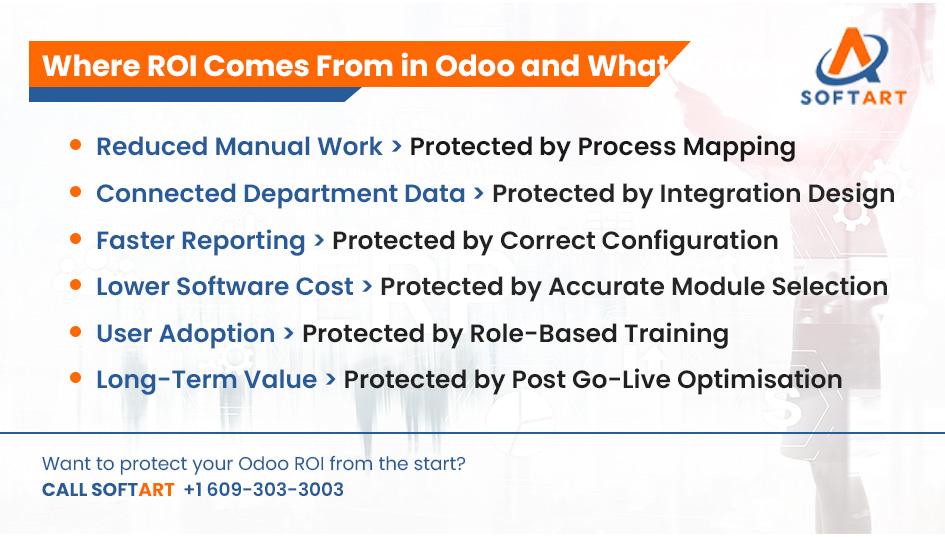
ROI from Odoo comes from four sources: reduced manual work, connected data across departments, faster reporting, and lower total software cost compared to the stack Odoo replaces.
Here’s what each looks like operationally:
- Reduced Manual Work. A confirmed sales order automatically updates inventory, generates an invoice, and triggers a delivery workflow. Nobody re-enters the same data across three systems. Staff time redirected away from data entry is measurable and recurring.
- Connected Data Across Departments. Finance sees inventory movement. Sales sees stock levels. Operations sees outstanding invoices. Decisions are made on current data, not yesterday’s export.
- Faster Reporting. Month-end doesn’t require a week of manual consolidation. Dashboards pull live data. Leadership gets accurate numbers faster.
- Lower Total Software Cost. A business replacing five separate SaaS subscriptions with Odoo eliminates five license fees, five sets of integrations, and five support contracts.
Each ROI source requires something from the consulting layer to actually materialise:
- Reduced manual work requires correct workflow configuration, which requires accurate process mapping
- Connected data requires integration design, which requires an integration map
- Faster reporting requires correct chart of accounts and reporting structure setup
- Lower software cost requires accurate module selection so nothing is bought unnecessarily
Poor user adoption accounts for up to 70% of ERP ROI failure post go-live, according to Gartner research cited widely across 2025 and 2026 ERP industry analysis. Adoption is a consulting output, not an implementation output. It depends on how well the system was configured to match real workflows and how well users were trained on those specific workflows.
What Does Maximizing ROI From Odoo Implementations Require in Practice?
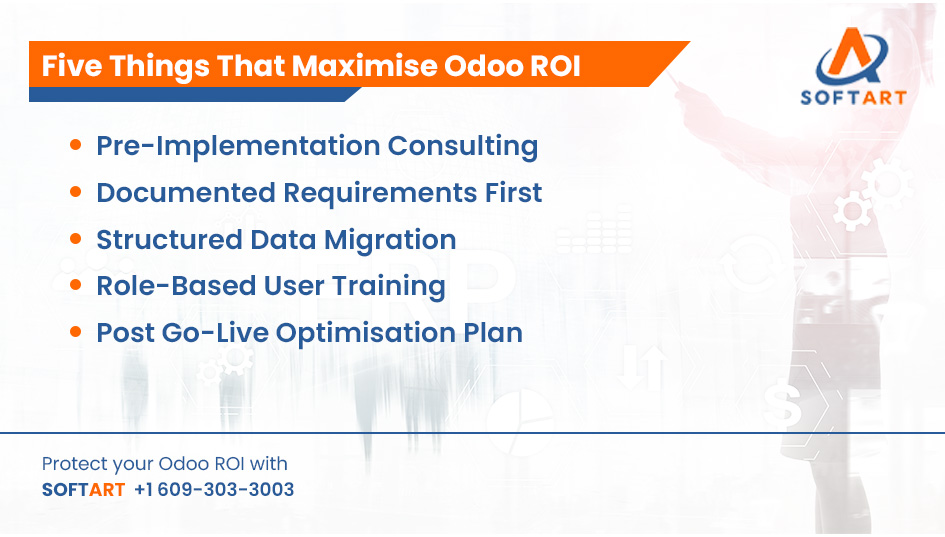
Maximizing ROI from Odoo implementations requires five things. Each one is a consulting deliverable, not an implementation deliverable.
- Pre-Implementation Consulting Engagement. A structured discovery phase before any configuration starts. This produces the BRD, module selection rationale, and integration map described above. Without it, the project runs on assumptions.
- Documented Requirements Before Configuration. Configuration that starts without signed-off requirements will drift. Every undocumented assumption becomes a potential rework item.
- Structured Data Migration. Clean data in Odoo means accurate reports from day one. Data migrated without a test run means problems are discovered after go-live, when fixing them costs more.
- Role-Based User Training. Training on how the specific configured system works for a specific job role, not generic Odoo software training. Users who understand how their workflows work inside Odoo adopt it. Users who don’t work around it.
- Post Go-Live Optimisation Plan. The first 60 to 90 days after go-live surface gaps that testing didn’t catch. A planned optimisation engagement resolves them before they become permanent workarounds.
According to Doodex’s 2026 Odoo consulting analysis, implementations with structured consulting engagements reduce post go-live support costs by 30 to 40% on average. The reason is that problems caught during consulting cost less to fix than problems caught after go-live.
What Do SoftArt’s Odoo Consulting Services Include for USA Businesses?
SoftArt Solutions Inc. delivers Odoo consulting services for USA businesses across the full engagement cycle, from pre-implementation advisory through to post go-live optimisation.
The pre-implementation consulting engagement covers:
- ERP fit assessment before any implementation commitment
- Business requirements documentation with client sign-off
- Module selection based on documented workflows
- Integration architecture and planning
- Data readiness review and migration strategy
- Full implementation scoping with cost and timeline estimate
The implementation and post go-live consulting covers:
- Functional configuration and workflow design
- UAT planning and execution support
- Role-based user training
- Post go-live optimisation and system health review
SoftArt’s odoo consultants include experienced odoo functional consultants who map real business workflows to Odoo’s configuration before any module is touched. The team has delivered 100+ ERP implementations across Odoo, Oracle NetSuite, Oracle Cloud ERP, and Microsoft Dynamics 365.
Because SoftArt works across platforms, the fit assessment is genuinely advisory. If Odoo serves your business requirements, SoftArt configures it correctly. If another platform is a better match at your stage, you’ll hear that before any budget is committed.
For USA businesses already on Odoo whose system isn’t delivering the returns they expected, SoftArt’s post go-live consulting engagement covers system audit, gap analysis, workflow optimisation, and a structured improvement plan.
Book an Odoo Consulting Session With SoftArt
If your Odoo implementation is being planned, has stalled, or is live but underperforming, a structured consulting engagement is the fastest way to identify where the problem is and what it will take to fix it.
SoftArt offers a standalone pre-implementation Odoo consulting engagement for USA businesses that covers everything from fit assessment to a scoped implementation estimate, before any project commitment is required.
Book an Odoo consulting session with SoftArt.
- Email: info@softart.co
- US: +1 609-303-3003 | Canada: +1 609-303-3003 | UAE: +971 521490790
Frequently Asked Questions
What Is the Difference Between Odoo Consulting and Odoo Support?
Odoo consulting is strategic and advisory, covering fit assessment, requirements, and configuration design. Odoo support is operational, resolving live system issues, bugs, and user queries after go-live.
How Long Does a Pre-Implementation Odoo Consulting Engagement Take?
Most pre-implementation consulting engagements run two to four weeks for SMBs. Complex mid-market or multi-entity requirements take four to six weeks. Output is a BRD, module plan, integration map, and scoped implementation estimate.
Do I Need an Odoo Functional Consultant if I Have an Internal IT Team?
Yes. Internal IT teams handle infrastructure and technical tasks. An odoo functional consultant maps business workflows to Odoo configuration, which requires ERP domain knowledge and Odoo-specific expertise that most internal IT teams don’t have.
Can Odoo Consulting Services Help if My Current Odoo Setup Is Underperforming?
Yes. A post go-live consulting engagement starts with a system audit to identify gaps between how Odoo is configured and how the business actually operates. SoftArt delivers a structured optimisation plan covering workflow fixes, reporting corrections, and module additions where needed.