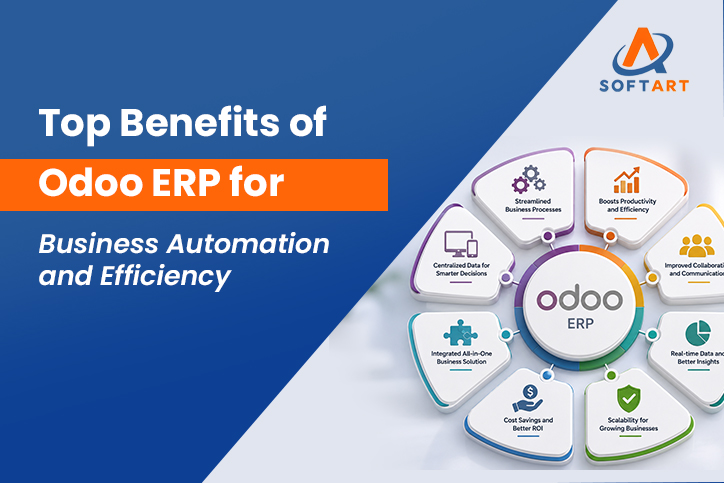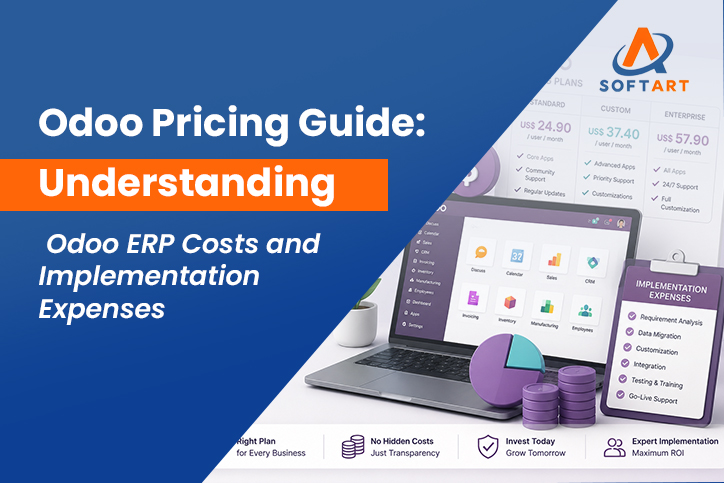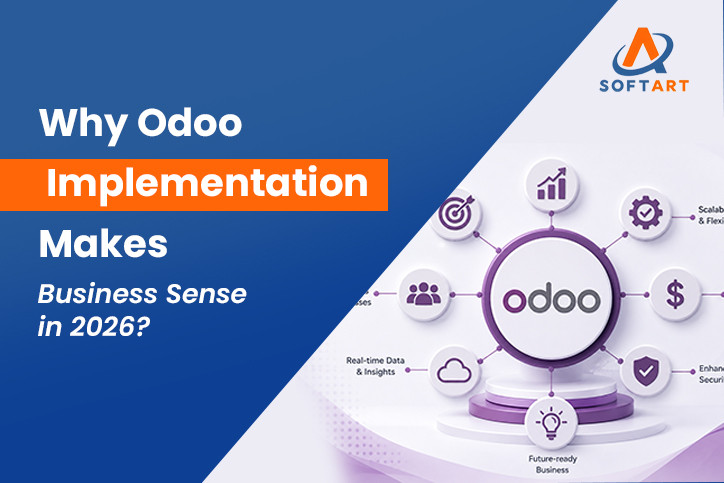
Your business didn’t stall because of a bad product or a weak team. It stalled because the systems running it couldn’t keep up. Finance is on one tool. Inventory is on another. Sales is still copying data into spreadsheets. Nobody trusts the numbers.
In 2026, Odoo implementation gives SMBs and mid-market businesses a modular, AI-ready ERP that connects every department without the enterprise price tag of SAP or traditional Oracle setups.
SoftArt Solutions Inc. is a certified Odoo partner with 20+ years of ERP delivery experience helping USA businesses evaluate fit, scope correctly, and implement Odoo from day one.
Read on to understand what’s driving this shift, what it costs, and what separates a strong Odoo implementation partner from one that disappears after go-live.
What Has Changed About ERP Buying Decisions in 2026?
Businesses are choosing ERP platforms based on implementation speed, modular pricing, AI readiness, and integration depth, not feature lists alone.
The rigid, single-vendor systems that dominated a decade ago are losing ground. Businesses want platforms they can start lean and grow into. Budget pressure is real. Getting locked into the wrong platform for five years is now a boardroom conversation, not just an IT one.
Three things make 2026 a meaningful year for this decision specifically:
- Odoo’s Growth Rate Signals Market Movement. Odoo generated €650 million in billing revenue in 2025 with 42% annual recurring revenue growth, according to Odoo SA. The platform is adding 13,000+ new clients every month. Businesses that previously accepted expensive legacy ERP contracts are actively moving.o
- NetSuite Pricing Increases Are Pushing Mid-Market Buyers to Evaluate Alternatives. According to a 2026 North America implementation report by Octura Solutions, NetSuite-to-Odoo migrations now represent a growing share of new Odoo projects in the USA and Canada, with that share expected to increase through 2027.
- The Overall ERP Market Is Expanding Fast. The global ERP software market is projected to reach $123.41 billion by 2030, growing at 11.7% CAGR, according to Grand View Research.
Businesses that delay this decision don’t stay still. They fall further behind competitors who’ve already built cleaner operations.
What Is Odoo Implementation and What Does It Include?
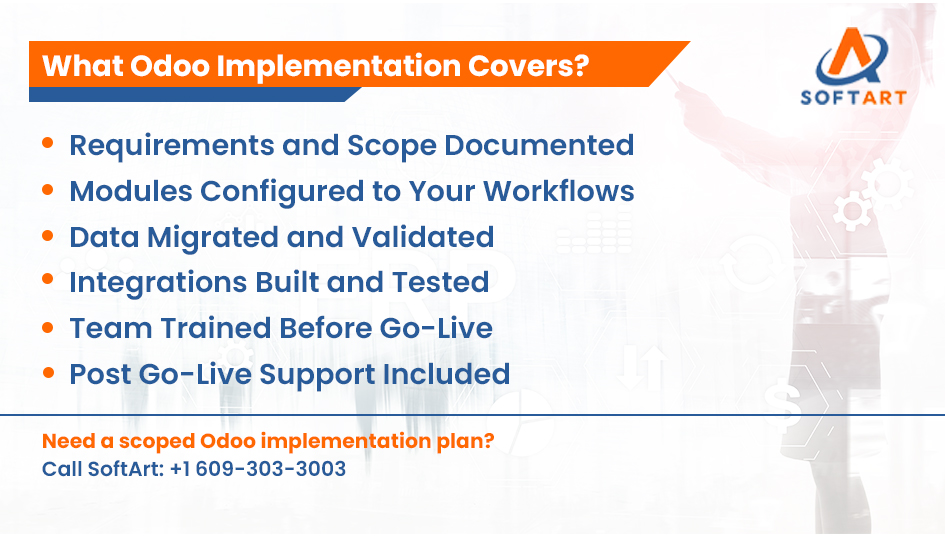
Odoo implementation is the process of configuring the Odoo ERP platform for a specific business, covering module setup, workflow configuration, data migration, integrations, user training, and go-live support.
It’s not installing software. A proper Odoo implementation covers six things:
- Mapping your actual business workflows
- Migrating your existing data cleanly into the new system
- Connecting Odoo to the tools you’re already running
- Configuring user roles, approvals, and reporting
- Training your team before go-live
- Stabilising the system after go-live before the project closes
When any of those stages are skipped or rushed, the problems show up fast. Teams work around the system instead of in it. Data doesn’t match. Reports aren’t trusted. That’s not an Odoo problem. That’s an implementation problem.
What Makes Odoo’s Modular Structure Different From Traditional ERP?
Modular ERP means you choose only the specific application modules your business needs, rather than buying a full platform upfront.
Odoo offers 70+ core business apps covering finance, inventory, sales, CRM, manufacturing, HR, ecommerce, and project management. You start with what your operations need today. You add more as the business grows.
Odoo comes in two editions:
- Odoo Community is free and open-source, suited to businesses with basic requirements and internal technical capacity.
- Odoo Enterprise is the paid version with full hosting options, advanced features, Odoo Studio, IoT support, and access to the certified partner network.
Most growing businesses implement Odoo Enterprise. It’s the version built for operational scale, not experimentation.
What Does Odoo Implementation Cost in the USA in 2026?
Odoo implementation cost in the USA isn’t a fixed number. It depends on user count, module selection, customisation depth, data complexity, integrations, and the partner you work with.
- Layer 1: Licensing. Odoo pricing plans USA are based on a per-user, per-month subscription for Odoo Enterprise. The rate varies by region and billing term. US pricing is higher than other markets. Always verify current rates at odoo.com/pricing directly, as subscription costs update periodically.
- Layer 2: Implementation services. This is where most budgets are underestimated. According to ERP Pilot’s 2026 Odoo Enterprise pricing analysis, license costs represent only 30 to 40% of the total year-one investment. Implementation services, covering configuration, data migration, integrations, training, and go-live support, make up the rest.
Total cost of ownership (TCO) is the full cost of running an ERP over time. It includes licensing, implementation, integrations, training, support, and maintenance, not just the subscription fee.
For US businesses, directional ranges based on market data look like this:
| Business Size | Typical Implementation Cost Range |
| Small (3–4 modules, under 25 users) | $15,000 to $40,000 |
| Mid-market (5–8 modules, integrations) | $75,000 to $150,000+ |
| Complex (multi-entity, heavy customisation) | $150,000 and above |
These are directional ranges based on market data. Actual costs depend on your specific scope, module count, data quality, integrations, and partner. Always request a formal scoped estimate before budgeting.
According to AppVerticals citing Bresdel’s 2026 ERP Adoption Statistics, Odoo Enterprise TCO for a 50-user business is estimated at $315,000 to $387,000 over three years. That’s up to 65% lower than comparable legacy ERP vendors at the same user scale.
How Does Odoo’s Cost Compare to NetSuite License Cost USA?
NetSuite license cost USA is quote-based and not publicly listed. Pricing depends on modules, user count, contract term, and implementation tier.
NetSuite for small business makes sense when the company needs strong multi-entity financial management, native ecommerce capabilities, or is planning significant international expansion from day one. For businesses that don’t need that depth yet, Odoo’s modular pricing and shorter implementation timeline often deliver better value at the SMB stage.
Neither platform is universally cheaper. Scope, modules, customisation, and partner fees shape the final number on both sides.
Will Odoo Work for a Business at Your Stage of Growth?
Odoo works well for businesses with 10 to 500 users, but it isn’t the right fit for every industry, compliance environment, or growth trajectory. Here’s an honest read.
Odoo fits well when:
- You’ve outgrown QuickBooks, Tally, Sage, Zoho Books, or spreadsheet-based operations
- Sales, inventory, finance, and operations run on separate disconnected tools
- You need full ERP functionality without SAP or NetSuite pricing
- You’re in manufacturing, distribution, ecommerce, retail, hospitality, construction, or professional services
- You want a system you can customise without vendor lock-in
You should evaluate further before committing when:
- Your finance environment involves complex multi-entity consolidation across many legal entities with different currencies and reporting standards
- Your business has deep dependencies on the Microsoft 365 or Azure ecosystem where Business Central may integrate more naturally
- Your compliance environment requires certifications that Odoo’s localisation doesn’t cover natively in your region
- You’re at enterprise scale with 500+ users and complex procurement or supply chain requirements where Oracle or SAP have deeper vertical depth
When Should a Business Evaluate NetSuite for Small Business Instead?
NetSuite for small business makes more sense when the company has multi-subsidiary requirements from day one or needs native revenue recognition. It’s also the stronger fit in industries where NetSuite has deep pre-built vertical functionality. For businesses that don’t need that depth yet, Odoo often delivers faster implementation and lower year-one cost.
What Does a Certified Odoo Partner Do That Others Don’t?
A certified Odoo partner is a firm officially recognised by Odoo SA to sell, implement, and support Odoo Enterprise. They’re held to defined training and delivery standards that freelancers and uncertified firms are not.
Odoo has 16,000+ partners across 160+ countries, according to Summit Partners and Odoo SA. Not all of them deliver at the same level. The gap shows up at the stages that matter most: data migration, integrations, UAT, and post-go-live stabilisation.
A certified Odoo partner delivers:
- Scoping before configuration. Requirements are documented and signed off before any module is touched.
- Structured data migration. Data is extracted, cleaned, mapped, test-migrated, and validated by business users before the live migration runs.
- Integration builds. Odoo connects to the tools the business was already running, such as Shopify, Salesforce, ADP, or legacy ERP systems.
- User acceptance testing. Real business users test real workflows. Go-live isn’t scheduled until sign-off is received.
- Post go-live support. The same team that built the system handles issues after go-live. The project doesn’t close the moment the system switches on.
A freelancer might configure modules at a lower day rate. But if the data migration fails, the integrations break, or the system goes live with untested workflows, the cost of fixing it later consistently exceeds what was saved upfront.
Plan Your Odoo Implementation With SoftArt
Businesses that wait for their current system to completely break before evaluating ERP spend more time, more money, and more energy on the transition than those who plan ahead.
SoftArt Solutions Inc. is a certified Odoo partner with 20+ years of ERP delivery experience. As an odoo implementation partner, SoftArt supports businesses across the full cycle, from requirements and scoping through to go-live and post-implementation support.
The team has delivered 100+ ERP implementations across Odoo, NetSuite, Oracle, and Microsoft Dynamics. That cross-platform experience means the assessment is honest. If Odoo fits, it’s implemented correctly. If another platform is a better match, you’ll hear that before any contract is signed.
For businesses evaluating odoo consulting services USA, SoftArt’s consultation covers fit assessment, module selection, and implementation scoping at no commitment.
Book an Odoo demo or consultation with SoftArt.
Email: info@softart.co
US: +1 609-303-3003 | Canada: +1 609-303-3003 | UAE: +971 521490790
Frequently Asked Questions
What industries benefit most from Odoo implementation?
Manufacturing, distribution, ecommerce, retail, hospitality, and professional services businesses benefit most. Odoo implementation covers operations, finance, inventory, and CRM in one connected platform.
Can a small business afford Odoo implementation services?
Yes. Odoo implementation services start around $15,000 for small businesses. Modular pricing means you pay only for the apps your operations actually need.
What should I ask an Odoo implementation partner before signing?
Ask about their documented process, data migration approach, UAT sign-off practice, and post go-live support. A reliable odoo implementation partner answers all four clearly.
How is a certified Odoo partner different from a freelancer?
A certified Odoo partner follows Odoo SA’s defined delivery standards. Freelancers don’t. The difference shows up during data migration, testing, and post go-live support.
Does Odoo implementation work for businesses already using NetSuite?
Yes. Businesses migrating from NetSuite for small business setups find Odoo’s modular structure and lower TCO a practical alternative for mid-market operations.
What does odoo consulting services USA cover before implementation starts?
Odoo consulting services USA covers fit assessment, module selection, integration planning, and scoping. It prevents expensive mistakes before implementation budget is committed.